Search the SPREP Catalogue

Refine Search Results

Tags / Keywords

Language

Available Online

Tags / Keywords

Available Online

26 result(s) found.

Sort by

You searched for

  • Collection BRB
    X
  • Related Countries Worldwide
    X
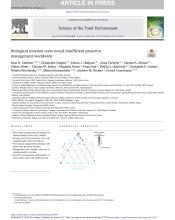
Global Economic Costs of Aquatic Invasive Alien Species
Biodiversity Conservation, BRB
Available Online

Ahmed, Danish A.

,

Angulo, Elena

,

Briski, Elizabeta

,

Capinha, César

,

Catford, Jane A.

,

Cuthbert, Ross N.

,

Dalu, Tatenda

,

Diagne, Christophe

,

Essl, Franz

,

Gozlan, Rodolphe E.

,

Leroy, Boris

,

Pattison, Zarah

,

Taylor, Nigel G.

,

Verbrugge, Laura

2021
Much research effort has been invested in understanding ecological impacts of invasive alien species (IAS) across ecosystems and taxonomic groups, but empirical studies about economic effects lack synthesis. Using a comprehensive global database, we determine patterns and trends in economic costs of aquatic IAS by examining: (i) the distribution of these costs across taxa, geographic regions, and cost types; (ii) the temporal dynamics of global costs; and (iii) knowledge gaps, especially compared to terrestrial IAS. Based on the costs recorded from the existing literature, the global cost of aquatic IAS conservatively summed to US$345 billion, with the majority attributed to invertebrates (62%), followed by vertebrates (28%), then plants (6%). The largest costs were reported in North America (48%) and Asia (13%) and were principally a result of resource damages (74%); only 6% of recorded costs were from management. The magnitude and number of reported costs were highest in the United States of America and for semi-aquatic taxa. Many countries and known aquatic alien species had no reported costs, especially in Africa and Asia. Accordingly, a network analysis revealed limited connectivity among countries, indicating disparate cost reporting. Aquatic IAS costs have increased in recent decades by several orders of magnitude, reaching at least US$23 billion in 2020. Costs are likely considerably underrepresented compared to terrestrial IAS; only 5% of reported costs were from aquatic species, despite 26% of known invaders being aquatic. Additionally, only 1% of aquatic invasion costs were from marine species. Costs of aquatic IAS are thus substantial, but likely underreported. Costs have increased over time and are expected to continue rising with future invasions. We urge increased and improved cost reporting by managers, practitioners and researchers to reduce knowledge gaps. Few costs are proactive investments; increased management spending is urgently needed to prevent and limit current and future aquatic IAS damages.
InvaCost, a Public Database of the Economic Costs of Biological Invasions Worldwide
Biodiversity Conservation, BRB
Available Online

Assailly, C.

,

Courchamp, F.

,

Diagne, C.

,

Gozlan, R. E.

,

Jarić, I.

,

Jourdain, F.

,

Leroy, B.

,

Nuninger, L.

,

Roiz, D.

,

Vaissière, A.-C.

2020
Biological invasions are responsible for tremendous impacts globally, including huge economic losses and management expenditures. Efficiently mitigating this major driver of global change requires the improvement of public awareness and policy regarding its substantial impacts on our socio-ecosystems. One option to contribute to this overall objective is to inform people on the economic costs linked to these impacts; however, until now, a reliable synthesis of invasion costs has never been produced at a global scale. Here, we introduce InvaCost as the most up-to-date, comprehensive, harmonised and robust compilation and description of economic cost estimates associated with biological invasions worldwide. We have developed a systematic, standardised methodology to collect information from peer-reviewed articles and grey literature, while ensuring data validity and method repeatability for further transparent inputs. Our manuscript presents the methodology and tools used to build and populate this living and publicly available database. InvaCost provides an essential basis (2419 cost estimates currently compiled) for worldwide research, management efforts and, ultimately, for datadriven and evidence-based policymaking.
The Isles of Scilly seabird restoration project: the eradication of brown rats (Rattus norvegicus) from the inhabited islands of St Agnes and Gugh, Isles of Scilly
Biodiversity Conservation, BRB
Available Online

Bell, E.

,

Boyle, D.

,

Buckley, P.

,

Floyd, K.

,

Garratt, W.

,

Lock, L.

,

Mason, S.

,

McCarthy, R.

,

Pearce, J.

,

Pearson, J.

,

St Pierre, P.

,

Sugar, K.

2019
As part of the Isles of Scilly Seabird Recovery Project, and directed by Wildlife Management International Ltd, the eradication of brown rats (Rattus norvegicus) from the inhabited islands of St Agnes & Gugh, Isles of Scilly was completed between October 2013 and April 2014 with the assistance of volunteers, and staff from the Royal Society for the Protection of Birds, Isles of Scilly Wildlife Trust and Natural England. Bait stations with cereal-based wax blocks containing bromadiolone at 0.005% w/w were established on a 40–50 metre grid over the island. With the presence of 85 residents on the 142 ha islands, this is the largest community-based brown rat eradication globally to date. Given the fact that a community is based on these islands, community engagement and advocacy was a vital and fundamental part of the eradication. Consultation for eradication began three years prior to the operation to explain the requirements for the proposed project and to assess support, but this built on many years of wider community engagement with seabird conservation. All of the residents supported the eradication of rats and vision of the project. The consultation and inclusion of the community in decision-making and management of the Isles of Scilly Seabird Recovery Project was a critical part of the operation and key to the success of the eradication. The community took ownership of the project and has committed to the on-going biosecurity requirements following the eradication of rats. The removal of brown rats from St Agnes and Gugh was a major achievement and provided the opportunity to restore the islands' communities of seabirds and other native species. This project provided an example of the effectiveness of ground-based rodent eradication techniques on an inhabited island and the lessons learnt during this operation can be used to help proposed eradications on other islands with communities and with terrain suitable for ground-based techniques.
It's not all up in the air: the development and use of ground-based rat eradication techniques in the UK
Biodiversity Conservation, BRB
Available Online

Bell, E.A.

2019
Eradication techniques using ground-based devices were developed in New Zealand in the early 1970s to target invasive rodents. Since then, different bait station designs, monitoring tools and rodenticide baits have been developed, and changes in field techniques have improved and streamlined these operations. The use of these techniques has been taken around the world to eradicate rodents from islands. Eradication technology has moved rapidly from ground-based bait station operations to aerial application of rodenticides. However, regulations, presence of and attitudes of island-communities and presence of a variety of non-target species precludes the aerial application of rodenticides on islands in many countries. As such, ground-based operations are the only option available to many agencies for the eradication of invasive rodents from islands. It is important to recognise that the use of ground-based operations should be a valid option during the assessment phase of any eradication proposal even in countries that can legally apply bait from the air; in many instances the use of ground-based techniques can be as economic and rapid. The use of ground-based operations can also facilitate opportunities for in-depth monitoring of both target and non-target species. Using examples of the techniques and developments used in five ground-based rat eradication operations from the UK demonstrates how these methods can be used safely and successfully around the world, even on islands in the order of hundreds of hectares and those with communities.
Island invasives : scaling up to meet the challenge.
Biodiversity Conservation, BRB
Available Online

Clout, M.N.

,

Martin, A.R.

,

Russell, J.C.

,

Veitch, C.R.

,

West, C.J.

2019
The papers in this volume were, with a few exceptions, presented at the third Island Invasives conference, held in Dundee, Scotland in July 2017. The papers demonstrate up-scaling in several aspects of eradication operations – not least in ambition, land area, operational size, global reach and of course financial cost. In the space of a few decades, the size of islands treated for invasive species has increased by five orders of magnitude – from a few hectares to over 100,000 ha or 1,000 km2. Meanwhile, the diversity of species being tackled has increased, as has the range of countries now actively carrying out island restoration work. Inspired by pioneers from New Zealand and Australia, principally, today the movement has spread to islands in all oceans and off all continents. This expansion has been informed by, and has in turn produced, growing experience in all aspects of this field, from non-target impacts to ecological responses to factors affecting eradication success. A major aim of publishing these Proceedings is to inform people who are, or will in the future be, planning new projects to free islands of invasive species. Regardless of its location or the target species involved, each successive operation builds on the experience of those who have gone before, and the papers in this volume represent an invaluable wealth of such experience.