Search the SPREP Catalogue

Refine Search Results

Tags / Keywords

Available Online

Tags / Keywords

Available Online

7965 result(s) found.

Sort by

You searched for

  • Collection Biodiversity Conservation
    X
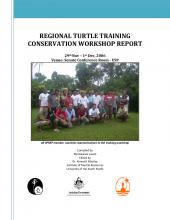
Regional turtle training conservation workshop report, 29 November - 1st December, 2006
Biodiversity Conservation
Available Online

Laveti, Merewalesi

,

MacKay, Dr. Kenneth

2006
The three days Marine Turtle Conservation Workshop in the region reflected an achievement as a successful outcome from the objective of the Turtle Conservation Project in Tuvalu, Fiji and Vanuatu implemented and coordinated by the Institute of Marine Resources (IMR) under the University of the South Pacific (USP). Fellow representatives are from various non government organisation, local community, tourist industry, government officials, SPREP staffs and regional representatives including Samoa, Tuvalu, Tonga, and the Solomon Islands. Altogether, 31 participants attended the workshop. Presentations were conclusively conducted by Dr. Ian Bell (Marine Biologist) assisted by Dr. Ken MacKay (IMR), Aisake Batibasaga (Dept. Fisheries), Alan Resture (IMR) and Lui Bell (SPREP). Participants were basically trained on appropriate scientific research methods on Turtle Conservation, these includes, identifying turtle species, identifying turtle tracks, identifying turtle nesting and feeding grounds, turtle tagging and collating and recording datas. The formulation of the network between representatives would allow information dissemination, increasing in capacity building and education and awareness on turtle conservation at national and regional level. However, SPREP installed the Turtle Research and Monitoring Database System to centralise and secure collated datas and reports on Turtle Research in the region. Conclusively, increasing in efforts, cooperation, networking, management and support on conserving marine turtles will contribute to the rehabilitation and restoring the lost population of the endangered sea turtles in the Pacific.

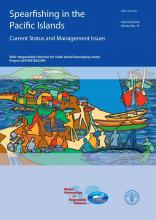
Spearfishing in the Pacific islands: current status and management issues
Biodiversity Conservation
Available Online

Gillett, Robert

,

Moy, Wayne

2006
Spearfishing is growing in importance in the Pacific Islands. While its management has featured as a topic in some regional-level meetings, detailed information on spearfishing is surprisingly scarce. In early 1994, the Secretariat of the Pacific Community (SPC) proposed to consolidate information on spearfishing in the Pacific Islands. The original intent was to undertake a review of the available literature through a desk study. With the realization that many issues related to spearfishing are undocumented, the strategy was changed to include some field work. These activities were supported by the FAO FishCode Programme. This report reviews spearfishing in selected Pacific Island countries and identifies the important species caught by and the major problems associated with the method. It further considers possible interventions to mitigate these problems and the assistance that is likely to be required by Pacific Island countries in the management of their spearfisheries. Visits to five countries undertaken during the study show that there are very large differences between countries, and between locations within a single country, in the level and type of spearfishing activities. General conclusions on the management of spearfishing include: (a) for several reasons, a complete ban of scuba spearfishing coupled with effective enforcement is the single most important spearfishing management measure; (b) spearfishing effort must be managed along with other forms of inshore fishing, since attempts at restricting spearfishing alone are not likely to be successful as fishing effort may b easily transferred to other small-scale fishing methods; and (c) in the management of inshore fisheries, including that of spearfishing, interventions must be formulated, initiated and enforced at the local level, preferably with some assistance from the national level.