Search the SPREP Catalogue

Refine Search Results

Tags / Keywords

Available Online

Tags / Keywords

Available Online

3124 result(s) found.

Sort by

You searched for

  • Collection Climate Change Resilience
    X
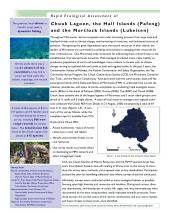
Rapid ecological assessment of Chuuk lagoon, the Hall islands (Pafeng) and the Mortlock Islands (Lukeisen)
Climate Change Resilience
Available Online

Conservation Society of Pohnpei

Throughout Micronesia, marine ecosystems are under increasing pressure from large-scale and localized threats such as climate change, overharvesting of resources, and land-based sources of pollution. Recognizing the great dependence upon the natural resources of their islands, the leaders of Micronesia are committed to assisting communities in managing these resources for their continued use. One Micronesia-wide movement for addressing these critical threats is the establishment of protected areas networks. Well-managed protected areas create healthy reproductive populations of coral reef assemblages, more resilient to threats such as climate change, serving to replenish fish and corals at local and regional scales. In the past 3 years, the Conservation Society of Pohnpei, the Kosrae Conservation and Safety Organization, the Yap Community Action Program, the Chuuk Conservation Society (CCS), the Micronesia Conservation Trust, and the Nature Conservancy have partnered with the communities, State and National governments of the Federated States of Micronesia (FSM) to understand the current distribution, abundances, and status of marine ecosystems by conducting rapid ecological assessments (REAs) in the states of Pohnpei (2005), Kosrae (2006), Yap (2007) and Chuuk (2008). Chuuk State contains one of the largest lagoons in Micronesia, and 3 outer island groups comprised of 11 atolls and 3 single islands. A team of local resource managers and regional scientists conducted the Chuuk REA from 28 July to 21 August, 2008, encompassing a total of 69 sites in 21 days. A summary of the survey follows, while the complete report is available from CCS.
Development, forest conservation and adaptation to climate change: a case for integrated community-based sustainability in rural Vanuatu
Climate Change Resilience
Available Online

Warrick Olivia

This paper is concerned with integrating adaptation to climate change with local development in the context of a climate change mitigation project for reducing emissions from deforestation and forest degradation. It is argued that integration will enhance locally appropriate and sustainable outcomes necessary for effective forest conservation in the context of rural Vanuatu. Concurrently, a community- based approach to assessing vulnerability is proposed whereby locally pertinent manifestations of climate- related exposure and adaptive capacity form the baseline of adaptive decision-making for integrated forest conservation and development. The approach is illustrated by a discussion of vulnerability and local development needs in the Tangoa Island community, South Santo, Vanuatu - a community particularly affected by tropical cyclones. Although effective adaptive strategies have evolved over time in Tangoa, these are unlikely to withstand the likely changes in magnitude and (perhaps) frequency of cyclones into the future with climate change. This is due to evolving non-climate stresses that largely intersect with locally defined development needs. Opportunities exist to reduce vulnerability to climate change by development pathways that address particular non-climate stresses. This provides a practical and tangible way of engendering community-based adaptation that would otherwise be unlikely in rural Vanuatu. The approach has application in other rural developing communities, both in Vanuatu and other developing countries.
Climate change and social change: vulnerability and adaptation in rural Vanuatu / Olivia Warrick
Climate Change Resilience
Available Online

Warrick Olivia

What is the nature of vulnerability and resilience to climate change at the community scale in Pacific island countries (PICs)? What approaches to climate change adaptation are most appropriate at this scale? These questions are examined in the context of rural Vanuatu, a Melanesian least developed country particularly susceptible to changes in climate variability and extremes. Fieldwork on the islands of Santo. Efate and Mota Lava interpreted vulnerability by beginning with local perceptions and experiences of dealing with climate risks. Vulnerability to climate arises from a context of rapid social change. Predominantly 'non-climate' factors such as population growth, land issues, changing traditional governance and eroding traditional knowledge are linked to changing agricultural practices, natural resource degradation, and increasing reliance on imports. These factors and processes affect the ways and degree to which communities are able to cope with climate stresses such as tropical cyclones, drought and heavy rain. However, research findings challenge the common notion that Pacific Island communities are inherently vulnerable; each community engages endogenous mechanisms of resilience. Aspects of this resilience may be threatened however especially where resilience depends on flexibility and self sufficiency, and particularly given increasing climatic uncertainty in the future, hi this context therefore, 'adaptation to climate change' requires communities to adapt to both changing climatic and social situations.