Search the SPREP Catalogue

Refine Search Results

Tags / Keywords

Available Online

Tags / Keywords

Available Online

3127 result(s) found.

Sort by

You searched for

  • Collection Climate Change Resilience
    X
Climate Change and the Great Barrier Reef: a vulnerability assessment : a vulnerability assessment
Climate Change Resilience, Biodiversity Conservation
Available Online

E. Johnson, Johanna

,

Marshall, A. Paul

2007
The Great Barrier Reef is one of the truly majestic places on our planet. Its size and brilliance make is observable even from space. Few ocean areas are known as well globally as the 2,300 km of reefs that extend over the Australian east coast. Comprised of more than 2,900 individual reefs that form its foundation, the Great Barrier Reef World Heritage Area encompasses a diversity of habitats, plants and animals of outstanding universal value. Scattered throughout its footprint are islands, mangroves and marine life of infinite variety. Like the Galapagos, the Great Barrier Reef has singular characteristics found nowhere else on Earth But, all of this is under threat as never before. Global climate change is a virtual sword of Damocles hanging over the very heart of the Great Barrier Reef. History reveals that reefs have been faced with changes in the past, including fluctuations in water temperature, sea level and acidification. Climate change has accelerated this rate of change, coinciding with mounting pressure from human uses. These threats are certainly not unique to the Great Barrier Reef. Around the world, coral reefs are faced with impacts from poor water quality, overfishing, physical damage and climate change. Experts estimate that 20 percent of the world’s coral reefs have been effectively destroyed and show no prospect of recovery, another 24 percent are under imminent risk of collapse through human pressures and 26 percent more are under longer term threat. What makes the Great Barrier Reef unique is that, so far, it has remained in relatively good condition compared to other reefs around the world.
Just change: critical thinking on global issues:|What's climate change?|The twin crises of climate change|Natural hazard mitigation: the role of insurance and international disaster aid|The development of biofuels in the Pacific|Listening to a whisper: Gender and vulnerability to climate change|An interview with Annie Homasi, coordinator of the Tuvalu Climate Action network and the Tuvalu Association of NGOs|Noah's Arc to save drowning Tuvalu|Pacific island vulnerability to tropical cyclones: Facing the perils in a warming world|Managing climate change, Fijian style|The tides are getting higher and higher: A Pacific voice on climate change|Revitalising customary knowledge to cope with disasters in the face of global warming|The Vanuatu carbon credits project: supporting Pacific development through reducing emissions and protecting forests|Shifting tides: indegenous responses to global climate change|NZAID's role in the Pacific on climate change
Climate Change Resilience, Biodiversity Conservation
Available Online

Dev-Zone

2007
During my childhood … We never experienced severe sea flooding. There were storms, but they weren’t that bad. As the sea levels continue to rise in Kiribati, several king tides hit the island. Saltwater intrusion affects the quality of water in wells; floods taro patches, gardens, and puts stress on plants/trees which are very important to the life and culture of an I-Kiribati
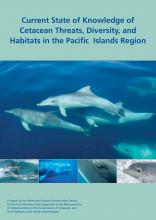
Current state of knowledge of Cetacean Threats, Diversity and Habitats in the Pacific Islands Region / by Cara Miller
Climate Change Resilience, Biodiversity Conservation
Available Online

Miller, Cara

2007
This report provides an overview of the current state of knowledge of cetacean diversity, habitat and threats in the Pacifi c Islands Region. The boundaries of the Pacifi c Islands Region (Chapter 1), as defi ned by the Convention of Migratory Species (CMS) Memorandum of Understanding (MoU) for the Conservation of Cetaceans and their Habitats in the Pacifi c Islands Region (CMS 2006), are the marine areas under the jurisdiction of each Country or Territory of the Pacifi c Islands Region, and extend to the area defi ned by the Noumea Convention, i.e., between the Tropic of Cancer and 60° South latitude, and between 130° East longitude and 120° West longitude. The region stretches over some 10,000 kilometres from east to west and 5,000 kilometres from north to south, with a combined economic exclusion zone (EEZ) of approximately 30 million km². This region contains 22 Pacifi c Island Countries and Territories, as well as a portion of the Australian continent, both the North and South Islands of New Zealand, and a portion of the Hawaiian Islands. The region is purported to hold the most extensive and biologically diverse reefs in the world, the deepest ocean trenches, the world’s largest tuna fi shery, as well as a range of globally threatened species such as sea turtles, dugongs and cetaceans (UNDP 1999)