Search the SPREP Catalogue

Refine Search Results

Language

Available Online

Available Online

38 result(s) found.

Sort by

You searched for

  • Collection Climate Change Resilience
    X
  • Subject Climatic changes
    X
The state of agricultural dommodity markets 2018. agricultural trade, climate change and food security
Environmental Governance, Climate Change Resilience, BRB
Available Online
2018
This edition of The State of Agricultural Commodity Markets focuses on the complex and underexplored intersection between agricultural trade, climate change and food security. It is clear that we cannot tackle hunger without finding adaptation and mitigation solutions to climate change in agriculture and food systems. It is also clear that the uneven impact of climate change across regions and countries, and the corresponding changes in food availability and access will affect international trade patterns and trade routes. This report supports these discussions by providing an in-depth analysis of the Paris Agreement and the WTO agreements to enhance clarity and provide guidance on policy options that could strengthen the mutually supportive role of these accords in tackling climate change and hunger. Wide-ranging policy actions are necessary to ensure that trade will contribute to the efforts aimed at ensuring food security and promoting adaptation and mitigation to climate change. The uneven impact of climate change across the world and its implications for agricultural trade, especially for developing countries, underlines the need for a balanced approach to policies, which should enhance the adaptive role of trade, while supporting the most vulnerable.
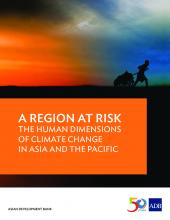
A region at risk - The human dimensions of climate change in Asia and the Pacific
Climate Change Resilience, Biodiversity Conservation
Available Online

Asian Development Bank

2017
The Asia and Pacific region is extremely vulnerable to the impacts of climate change. Unabated warming could significantly undo previous achievements of economic development and improvements of living standards. At the same time, the region has both the economic capacity and weight of influence to change the present fossil-fuel based development pathway and curb global emissions. This report sheds light on the regional implications of the latest projections of changes in climate conditions over Asia and the Pacific. The assessment concludes that, even under the Paris consensus scenario in which global warming is limited to 1.5°C to 2°C above preindustrial levels, some of the land area, ecosystems, and socioeconomic sectors will be significantly affected by climate change impacts, to which policy makers and the investment community need to adapt to. However, under a Business-As-Usual (BAU) scenario, which will cause a global mean temperature rise of over 4°C by the end of this century, the possibilities for adaptation are drastically reduced. Among others, climate change impacts such as the deterioration of the Asian “water towers”, prolonged heat waves, coastal sea-level rise and changes in rainfall patterns could disrupt ecosystem services and lead to severe effects on livelihoods which in turn would affect human health, migration dynamics and the potential for conflicts. This assessment also underlines that, for many areas vital to the region’s economy, research on the effects of climate change is still lacking.