Search the SPREP Catalogue

Refine Search Results

Language

Available Online

Available Online

32 result(s) found.

Sort by

You searched for

  • Collection Climate Change Resilience
    X
  • Publication Year 2016
    X
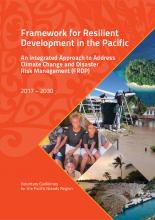
Framework for Resilient Development in the Pacific: An Integrated Approach to Address Climate Change and Disaster Risk Management (FRDP) 2017 - 2030
Climate Change Resilience, Biodiversity Conservation
Available Online
2016
Climate change exacerbates the magnitude and impacts of climate variability and some natural hazards. The existence of some Pacific Island countries (PICs) is threatened by climate change. Pacific Island countries and territories (PICTs) are highly exposed to a range of natural hazards of hydro-meteorological origin (such as cyclones, droughts, landslides and floods) and geological origin (including volcanic eruptions, earthquakes and tsunamis). These hazards often lead to disasters, which affect thousands of people and exacerbate existing development challenges in the region. Climate change predictions identify changes for the Pacific including an increase in extreme hot days and warm nights, extreme rainfall events, intensity of tropical cyclones in the South Pacific, sea level rise and ocean acidification. Climate change is increasing the risks from weather related disasters and posing new impacts to the region. Climate change impacts also cause progressive long-term degradation to the natural environment, to critical ecosystems (e.g. coral reefs), and to social and economic systems, resulting in loss and damage to the system upon which Pacific Island communities depend for their subsistence and livelihoods.
Global threats from invasive alien species in the twenty-first century and national response capacities
Climate Change Resilience, BRB
Available Online

Blumenthal, Dana M.

,

Bradley, Bethany A.

,

Dukes, Jeffrey S.

,

Early, Regan

,

Gonzalez, Patrick

,

Grosholz, Edwin D.

,

Ibañez, Ines

,

Lawler, Joshua J.

,

Miller, Luke P.

,

Olden, Julian D.

,

Sorte, Cascade J.B.

,

Tatem, Andrew J.

2016
Invasive alien species (IAS) threaten human livelihoods and biodiversity globally. Increasing globalization facilitates IAS arrival, and environmental changes, including climate change, facilitate IAS establishment. Here we provide the first global, spatial analysis of the terrestrial threat from IAS in light of twenty-first century globalization and environmental change, and evaluate national capacities to prevent and manage species invasions. We find that one-sixth of the global land surface is highly vulnerable to invasion, including substantial areas in developing economies and biodiversity hotspots. The dominant invasion vectors differ between high-income countries (imports, particularly of plants and pets) and low-income countries (air travel). Uniting data on the causes of introduction and establishment can improve early-warning and eradication schemes. Most countries have limited capacity to act against invasions. In particular, we reveal a clear need for proactive invasion strategies in areas with high poverty levels, high biodiversity and low historical levels of invasion.