Search the SPREP Catalogue

Refine Search Results

Language

Available Online

Available Online

41 result(s) found.

Sort by

You searched for

  • Available Online Yes
    X
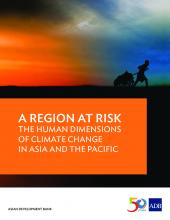
A region at risk - The human dimensions of climate change in Asia and the Pacific
Climate Change Resilience, Biodiversity Conservation
Available Online

Asian Development Bank

2017
The Asia and Pacific region is extremely vulnerable to the impacts of climate change. Unabated warming could significantly undo previous achievements of economic development and improvements of living standards. At the same time, the region has both the economic capacity and weight of influence to change the present fossil-fuel based development pathway and curb global emissions. This report sheds light on the regional implications of the latest projections of changes in climate conditions over Asia and the Pacific. The assessment concludes that, even under the Paris consensus scenario in which global warming is limited to 1.5°C to 2°C above preindustrial levels, some of the land area, ecosystems, and socioeconomic sectors will be significantly affected by climate change impacts, to which policy makers and the investment community need to adapt to. However, under a Business-As-Usual (BAU) scenario, which will cause a global mean temperature rise of over 4°C by the end of this century, the possibilities for adaptation are drastically reduced. Among others, climate change impacts such as the deterioration of the Asian “water towers”, prolonged heat waves, coastal sea-level rise and changes in rainfall patterns could disrupt ecosystem services and lead to severe effects on livelihoods which in turn would affect human health, migration dynamics and the potential for conflicts. This assessment also underlines that, for many areas vital to the region’s economy, research on the effects of climate change is still lacking.
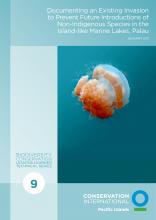
Documenting an existing invasion to prevent future introductions of non-indigenous species in the island-like marine lakes, Koror, Palau
Biodiversity Conservation, BRB
Available Online

Patris, Sharon ... [et al.]

2011
This document is part of a technical report series on conservation projects funded by the Critical Ecosystem Partnership Fund (CEPF) and the Conservation International Pacific Islands Program (CI-Pacific). The main purpose of this series is to disseminate project findings and successes to a broader audience of conservation professionals in the Pacific, along with interested members of the public and students. The reports are being prepared on an ad-hoc basis as projects are completed and written up. In most cases the reports are composed of two parts, the first part is a detailed technical report on the project which gives details on the methodology used, the results and any recommendations. The second part is a brief project completion report written for the donor and focused on conservation impacts and lessons learned. The CEPF fund in the Polynesia-Micronesia region was launched in September 2008 and will be active until 2013. It is being managed as a partnership between CI Pacific and CEPF. The purpose of the fund is to engage and build the capacity of non-governmental organizations to achieve terrestrial conservation. The total grant envelope is approximately US$6 million, and focuses on three main elements: the prevention, control and eradication of invasive species in key biodiversity areas (KBAs); strengthening the conservation status and management of a prioritized set of 60 KBAs and building the awareness and participation of local leaders and community members in the implementation of threatened species recovery plans.