Search the SPREP Catalogue

Refine Search Results

Tags / Keywords

Tags / Keywords

8933 result(s) found.

Sort by

You searched for

  • Available Online Yes
    X
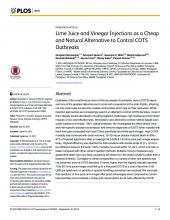
Lime juice and vinegar injections as a cheap and natural alternative to control COTS outbreaks
BRB
Available Online

Moutardler, Gregoire ... et al.

2015
Outbreaks of the corallivorous crown-of-thorns seastar Acanthaster planci (COTS) represent one of the greatest disturbances to coral reef ecosystems in the Indo-Pacific, affecting not only coral reefs but also the coastal communities which rely on their resources. While injection approaches are increasingly used in an attempt to control COTS densities, most of them display severe drawbacks including logistical challenges, high residual environmental impacts or low cost-effectiveness. We tested a new alternative control method based upon acidic injections of cheap, 100% natural products. We investigated the lethal doses, intraand inter-specific disease transmission and immune responses of COTS when injected with fresh lime juice (extracted from local Citrus arantifolia) and white spirit vinegar. High COTS mortality was achieved with small volumes: 10–20 ml per seastar induced death in 89%/ 97% of injected specimens after an average 34.3 h/29.8 h for lime juice and vinegar respectively. Highest efficiency was reached for both solutions with double shots of (2 × 10 ml) in two different areas on the body: 100% mortality occurred within 12–24 h, which is similar or faster compared with other current injection methods. Multiple immune measures suggested that death was very likely caused by pH stress from the acidic solutions rather than a bacterial infection. Contagion to either conspecifics or a variety of other reef species was not observed, even at COTS densities 15 times higher than the highest naturally reported. 10 to 20 l lime juice/vinegar could kill up to a thousand COTS at a cost of less than 0.05 USD per specimen; no permits or special handling procedures are required. We conclude that injections of lime juice and vinegar offer great advantages when compared to current best practises and constitute a cheap and natural option for all reefs affected by COTS
South Pacific Regional Writeshop Evaluation
Climate Change Resilience
Available Online

Pacific Research and Evaluation Associates

2015
The Stockholm Environment Institute (SEI) and the International Strategy for Disaster Reduction (ISDR) collaborated with implementing partner SPREP to host a five day ‘Writeshop’ (workshop) in Fiji in 2011. The Writeshop was funded by the UNITAR Climate Change Capacity and Development (C3D+) Support programme. The objective/outcomes of the Writeshop were twofold: 1. To build capacity of young Pacific country scholars, practitioners and policymakers to write quality publishable papers in the area of climate change, particularly on climate change adaptation and the linkages to disaster risk reduction. 2. To produce quality publishable papers ready for peer-review and facilitate the publication of peer-reviewed articles in academic journals to inform the policy making process on climate change. This Writeshop evaluation was informed by desktop research, an online survey and interviews with some key stakeholders. The evaluation was guided by a set of evaluation questions. · Were approximately 16 quality publishable papers published in academic journals as a result of the Writeshop? · What factors have contributed to achieving or not achieving intended outputs and outcomes of the C3D+ project? · What progress toward the outcomes has been made by the C3D+ project? Has the C3D+ partnership between UNITAR and SPREP been appropriate and effective? · To what extent have the C3D+ project outputs and assistance contributed to outcomes of the PACC programme?