Search the SPREP Catalogue

Refine Search Results

Related Countries

Language

Available Online

Related Countries

Available Online

6 result(s) found.

Sort by

You searched for

Quantification and magnitude of losses and damages resulting from the impacts of climate change: modelling the transformational impacts and costs of sea level rise in the Caribbean
Climate Change Resilience
Available Online

Simpson, M.C...[et al.]

2010
The inextricable links between climate change and sustainable development have been increasingly recognised over the past decade. In 2007, the Intergovernmental Panel on Climate Change (IPCC)1 concluded with very high confidence that climate change would impede the ability of many nations to achieve sustainable development by mid-century and become a security risk that would steadily intensify, particularly under greater warming scenarios. Article 4.8 of the United Nations Framework Convention on Climate Change (UNFCCC) lists several groups of countries that merit particular consideration for assistance to adapt to climate change “especially: (a) small island countries, (b) countries with low-lying coastal areas, c) countries with areas prone to natural disasters.” Small Island Developing States (SIDS) have characteristics which make them particularly vulnerable to the effects of climate change, sea level rise (SLR) and extreme events, including: relative isolation, small land masses, concentrations of population and infrastructure in coastal areas, limited economic base and dependency on natural resources, combined with limited financial, technical and institutional capacity for adaptation.2
An overview of modeling climate change : impacts in the Caribbean region with contribution from the Pacific Islands, United Nations Development Programme (UNDP), Barbados, West Indies
Climate Change Resilience, Biodiversity Conservation
Available Online

Simpson, M.C...[et al.]

2009
The nations of CARICOM16 in the Caribbean together with Pacific island countries contribute less than 1% to global greenhouse gas (GHG) emissions (approx. 0.33%17 and 0.03%18 respectively), yet these countries are expected to be among the earliest and most impacted by climate change in the coming decades and are least able to adapt to climate change impacts. These nations’ relative isolation, small land masses, their concentrations of population and infrastructure in coastal areas, limited economic base and dependency on natural resources, combined with limited financial, technical and institutional capacity all exacerbates their vulnerability to extreme events and climate change impacts. Stabilising global GHG emissions and obtaining greater support for adaptation strategies are fundamental priorities for the Caribbean Basin and Pacific island countries. CARICOM leaders recently unveiled their collective position that global warming should be held to no more than 1.5°C19 and continue to develop a Climate Change Strategic Plan. The Pacific island countries have expressed their priorities for addressing climate change regionally through the Pacific Leaders’ Call to Action on Climate Change20 and the Pacific Islands Framework for Action on Climate Change 2006-2015.21
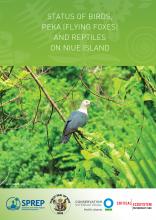
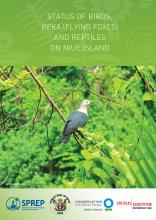
Status of birds and rodents on Niue following cyclone Heta in January 2004
BRB
Available Online

Butler, D.J.

,

Powlesland, D.J.

,

Westbrooke, I.M.

2006
On 6 January 2004. cyclone Heta devastated much of the South Pacific island nation of Niue. Extensive damage was done to forest, particularly of the north- western sector, with many trees up-rooted and others stripped of branches and foliage. This report details our findings from a survey of Niue's birds and rodents during 3-19 September 2004 and compares these with results from a similar survey in September 1994. Five-minute bird count data, an index of conspicuousness, from three transects showed that heahea (Polynesian triller,Lalagc maculosa) were more abundant in 2004 than in 1994, but mid (Polynesian starling, Aplonis tabuensis), kulukulu (purple-crowned fruit dove. Ptilinopus porpbyraecus) and lupe (Pacific pigeon. Ducula pacifica) had declined. The 28-64% decline in the lupe population per transect w as probably primarily as a result of hunting, rather than mortality caused by cyclone Heta. Counts of birds seen per kilometre along three sections of road (lower, upper, inland) were also compared with September 1994 data. However, for various reasons we doubt that the results accurately reflect population numbers. The 212 kiu (Pacific golden plover. Pluvial is fulva) counted at sites accessible from main roads in September 2004 was similar to the 226 seen in September 1994. Rat trapping results (captures per 100 trap-nights) along the same three transects for December 1994 and September 2004 were not significantly different. Both kuma (Pacific rat. Rattus exulans) and ship rats (R. rattus) were trapped, but kuma were found only in regenerating scrub, whereas ship rats were present in both scrub and forest. Recommendations for future work are made mainly in relation to the long-term conservation of lupe, a toaga (treasured) species of Niueans.