Search the SPREP Catalogue

Refine Search Results

Available Online

Available Online

5 result(s) found.

Sort by

You searched for

Dispositif de suivi de l'abondance et de l'impact du cerf - Fiche finale de capitalisation - PROTEGE
SPREP Publications, Biodiversity Conservation, BRB
Available Online

PROE / SPREP

2025
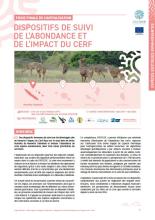
Des dispositifs innovants de suivi ont été développés afin de mesurer l’impact du Cerf Rusa sur le sous-bois de forêts humides de Nouvelle Calédonie et évaluer l’abondance de cette espèce envahissante, dans trois zones prioritaires du territoire. L’élaboration de ces dispositifs poursuit des objectifs complémentaires aux actions de régulation professionnelle mises en œuvre dans le cadre de PROTEGE. Le suivi vise notamment à réaliser un état initial et à évaluer les bénéfices des opérations de régulation, grâce à des outils adaptés à des zones d’intervention difficiles d’accès et caractérisées par une biodiversité exceptionnelle, plus de 80% des espèces végétales des forêts humides d’altitude étant endémiques à la Nouvelle-Calédonie. Un travail initial de sectorisation a permis mieux de caractériser les enjeux, les pressions sur l’environnement ainsi que le contexte socio-économique afin de délimiter les zones d’intervention prioritaires. Pour la première fois en Nouvelle-Calédonie, un protocole standardisé de mesure de l’impact des cerfs a été élaboré. Il s’appuie sur plusieurs indicateurs et prend en compte les spécificités des espèces végétales concernées et des contraintes associées à sa mise en œuvre. En complément, PROTEGE a permis d’élaborer une méthodeinnovante d’évaluation de l’abondance des cerfs, reposant sur l’utilisation d’un drone équipé de capteur thermique pour l’enregistrement de vidéos nocturnes. Un algorithme développé spécifiquement a par ailleurs vocation à réaliser automatiquement les détections à partir de ces vidéos, facilitant considérablement le traitement des données. La mise en œuvre de ce protocole pour la prospection de 4 700 hectares a révélé des densités de populations et des concentrations de hardes localement très élevées, atteignant par endroits des niveaux parmi les plus élevés enregistrés à l’échelle mondiale. Ces résultats fournissent des informations précieuses pour le ciblage de futures interventions et le suivi de leurs bénéfices. FICHE FINALE DE CAPITALISATION DU PROJET PROTEGE, financé par l'Union Européenne.
Conservation of kakerori (Pomarea dimidiata) in the Cook Islands in 2005/06
BRB
Available Online

Robertson Hugh A

,

Saul Edward K

2007
In 1989, the kakerori (Pomarea dimidiata) was one of the ten rarest bird species in the world, with a declining population of just 29 birds in the Takitumu Conservation Area (TCA) of southeastern Rarotonga. As a result of conservation management, the kakerori population rebounded, with up to 300 birds being recorded on Rarotonga and Atiu in 2004/05. The southern Cook Islands was, however, hit by five tropical cyclones over a 4-week period in February–March 2005, and much of the forest on exposed faces, spurs and ridges (traditional kakerori habitat) was severely damaged. The population survived remarkably well, with a minimum of 274 adults known to be alive in the TCA in August 2005. An additional 17 adults were found on Atiu between August 2005 and March 2006. The main\ casualties of the cyclones on Rarotonga appeared to be young birds (1–3 years old) and very old birds (> 20 years old). Because the population on Rarotonga remained well within the management target of 250–300 individuals, rat poisoning was again done fortnightly, as in the previous 2 years. Breeding productivity was exceptionally poor in 2005/06, mainly because of nesting failures or early fledgling deaths caused by abnormally wet conditions during the main fledging periods. Nests were more exposed to the elements because the cyclones had extensively defoliated the canopy. Furthermore, rats were often seen foraging during the day, apparently struggling to find food (few trees were fruiting). Only 22 fledglings were definitely seen in 2005/06; however, some territories were not checked or poorly checked during the breeding season, and some fledglings may have dispersed to better vegetated sites. We recommend that rat control should return to the weekly poisoning regime used during the 1989–2001 recovery phase of the kakerori management programme if the August 2006 census reveals that the population has fallen below 220 birds (a 20% decline from pre-cyclone levels). Otherwise the regime of the sustainable management phase (fortnightly poisoning) should continue.
Conservation of kakerori (Pomarea dimidiata) in the Cook Islands in 2004/05
BRB
Available Online

Robertson Hugh A

,

Saul Edward K

2006
In 1989, the kakerori (Pomarea dimidiata) was one of the ten rarest bird species in the world, with a declining population of just 29 birds living in south-eastern Rarotonga. As a result of conservation management, the kakerori population has rebounded, with a minimum of 281 birds on Rarotonga and 19 birds on Atiu in summer 2004/05. Since 2001, the emphasis of management in the Takitumu Conservation Area (TCA) on Rarotonga has shifted from the ‘recovery’ of kakerori to ‘sustaining’ the population at 250–300 individuals. In 2004/05, all rat bait stations were filled fortnightly, and so the labour costs were reduced by 30% to 34 person days, and toxin use (57 kg of Talon®—active ingredient brodifacoum) was reduced 81% from the peak year during the ‘recovery phase’. Kakerori breeding productivity was unusually high in 2004/05 because several pairs raised two broods. In the poisoned area, apparent breeding success was significantly higher (1.35 fledglings/breeding territory) than in the unpoisoned area (0.55 fledglings/ breeding territory); however, this difference was at least partly due to more effort being spent searching for fledglings in poisoned areas. A minimum of 59 fledglings was detected in 2004/05; however, some territories were not checked during the breeding season, and then a series of five tropical cyclones struck Rarotonga in a 4-week period in February/March 2005, which halted our fledgling searches, and caused severe damage to some habitat in the TCA. We expect that many kakerori perished during these cyclones; however, the population on Atiu, which was only affected by two of the five cyclones, survived unscathed. These catastrophic weather events highlighted the vulnerability of single-island endemic birds, and underlined the value of establishing an ‘insurance’ population on Atiu. We recommend that the poisoning regime should return to that used during the ‘recovery phase’ of the kakerori management programme if the August 2005 census reveals that the population has fallen below 220 birds (a 20% decline), otherwise the recent programme of fortnightly poisoning should continue.