Search the SPREP Catalogue

Refine Search Results

Language

Publication Year

Material Type

Available Online

Publication Year

Material Type

Available Online

5 result(s) found.

Sort by

You searched for

  • Collection BRB
    X
Scaling down (cliffs) to meet the challenge: the Shiants’ black rat eradication
Biodiversity Conservation, BRB
Available Online

Bambini, L.

,

Bell, E.

,

Campbell, G.

,

Churchyard, T.

,

Douse, A.

,

Floyd, K.

,

Ibbotson, J.

,

Main, C.E.

,

Nicolson, T.

,

Reid, R.

,

Taylor, P.R.

,

Tayton, J.

,

Varnham, K.

,

Whittington, W.

2019
A successful ground-based eradication of black rats (Rattus rattus) was undertaken on the remote, uninhabited Shiant Isles of north-west Scotland over winter (14 October–28 March) 2015–16. The rat eradication was carried out as part of the Shiants Seabird Recovery Project, which aims to secure long-term breeding habitat for protected seabirds and to attract European storm petrels and Manx shearwaters to nest on the Shiants. Throughout the eradication operation, teams were stationed on two of the three main Shiant islands (Eilean an Tighe, Eilean Mhuire), with access to the third (Garbh Eilean) via a boulder causeway from Eilean an Tighe. Bait (Contrac® blocks containing the anticoagulant bromadiolone 0.005% w/w), was deployed in a grid of 1,183 bait stations covering all areas of the islands and sea stacks. Bait stations were set 50 m apart, with intervals reduced to 25 m in coastal areas of predicted high rat density. Difficult areas were accessed by boat and cliff s of ~120 m in height were accessed by abseiling down ropes made safe using either bolted anchors or ground stakes. The team of staff and volunteers worked through difficult conditions, deploying bait and monitoring intensively for any surviving rats using a combination of tools. The islands were declared rat free in March 2018. This ambitious and challenging project has greatly enhanced UK capacity in rodent eradications for the purposes of conservation.
Long term rodent control in Rdum tal-Madonna yelkouan shearwater colony
Biodiversity Conservation, BRB
Available Online

Cabello, J.S. Santiago

,

Lago, P.

,

Varnham, K.

2019
Rodent predation on eggs and chicks is one of the main threats to procellariiform species in the Mediterranean, where the black rat (Rattus rattus) and brown rat (R. norvegicus) have been present on many islands for centuries. The yelkouan shearwater (Puffinus yelkouan) is an endemic Mediterranean seabird species classified as vulnerable. Malta holds up to 10% of the global population; the largest colony, Rdum tal-Madonna (RM), protected as a Natura 2000 site, hosts around 500 breeding pairs. This colony has been monitored since its discovery in 1969. A very low reproductive success due to rat predation was noticed in the late 1990s to early 2000s. In 2007 a seasonal rodent control programme was established during the breeding season of yelkouan shearwater to reduce rat predation on eggs and chicks. Rodent control took place between 2007 and 2010 and was reviewed and continued from 2012 to 2017. Breeding success since 2007 has been higher than 80%. In two other colonies with rat presence and where rodent control did not take place, the breeding success in 2016 and 2017 was substantially lower than in the colony with the rodent control programme. The European storm-petrel (Hydrobates pelagicus melitensis) only breeds in rat-free areas like remote sea caves or islets around the Maltese islands. In 2014, the first breeding attempt by European storm-petrel was recorded on the Maltese mainland at RM with a chick fledging successfully for the first time in 2016. The ongoing LIFE Arcipelagu Garnija project is assessing rat predation in all Maltese yelkouan shearwater colonies in order to establish predator control in the most important yelkouan shearwater breeding sites in 2018.
The eradication of black rats (Rattus rattus) from Dog Island, Anguilla, using ground-based techniques
Biodiversity Conservation, BRB
Available Online

Bell, E.

,

Connor, R.

,

Daltry, J.

,

Mukhida, F.

,

Varnham, K.

2019
Rat eradication techniques developed in New Zealand are a proven method for removing invasive rodents from islands worldwide. This technology moved rapidly from ground-based bait station operations to aerial application of rodenticides. Rat eradications on tropical islands using similar methods, have not always been as successful as those in temperate regions. As most previous eradications in the Caribbean have been on islands smaller than 50 ha, the eradication of black rats (Rattus rattus) from 207 ha Dog Island was a significant increase in size. Reptile and seabird populations on Dog Island had been in decline for a number of years and black rats were identified as the most likely factor. Following the feasibility study in 2007, the Dog Island Recovery Project was launched in 2011. This was a multiple-year project incorporating a ground-based eradication with establishment of biosecurity procedures to prevent reinvasion, alongside long-term monitoring of native species. Bait stations with cereal-based wax blocks containing brodifacoum at 0.005% w/w were established on a 30–50 m grid over the island. Interference with bait stations by non-target invertebrates, particularly crabs, was high and bait stations required moving or elevating to avoid this. However, there was no evidence of any non-target animals being killed or injured by the bait. Eradication success was confirmed in 2014.
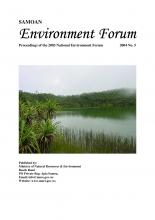
Samoan Environment Forum: proceedings of the 2003 National Environment Forum|Fe'ese'esea'iga i aiga ma nuu o Samoa : aafiaga o le tofa i Tuana'i ma Saanapu / Tu'u'u Ieti Taulealo|Some prospects for managing Merremia peltata / William Stuart Kirkham|The Green turtle tour project : a successful approach to aiding natural resources management in Samoa / Funealii Lumaava Sooa'emalelagi & Steve Brown|Persistent Organic Pollutants and persistent toxic substances in Samoa's Environment / Taule'ale'ausumai Laavasa Malua, Bill Cable & Paul F. Heveldt|Bridging the gap: building environment information linkages & network - a Pacific Samoan model / Satui Bentin & Leilani Duffy|The MNRE model for institutional strengthening in the public sector / Tu'u'u Ieti Taule'alo & Moilevao Elisaia Talouli|SPREP in Samoa / F. Vitolio Lui|Samoa: a paradise lost? / Le Mamea Sefulu Ioane|Taking of customary land for the new Salelologa township / Patea M. Setefano, Vaitogi I Vaitogi, Faanimo Warren & Fiona Sapatu|A study of indigenous knowledge and its role to sustainable agriculture in Samoa / Pitakia Tikai & Aaron Kama|PABITRA (Samoa): promoting capacity building via biodiversity studies by young Samoans / Nat Tuivavalagi
BRB
Available Online

MNRE

2004
Merremia peltata, disturbance ecology, tropical cyclones and Samoa. The biology and ecology of Merremia peltata are not well understood. While some regard the species as an exotic invader of Pacific Island ecosystems (Meyer. 2000). others identify the plant as a native species likely to be harmful to native ecosystems (Whistler, 1995a. 2002) or as either native or ancient Polynesian introduction behaving invasively (Space and Flynn.(2002). In Samoa, this species occurs up to an elevation of around 300 meters (Whistler 1995a). and thus only affects lowland ecosystems. This species increases its distribution and abundance in two ways, either vegetatively. by sprawling into neighboring areas and rooting from its nodes or by seeds, although early research in the Solomons observed a low seed viability rate, and creeping may thus be its primary means of reproduction (Bacon. 1982). M. peltata has apparently been in the Pacific for hundreds of years (Whistler, pers. com.) but has only become invasive in the years following tropical cyclones Ofa (1990) and Val (1991) according to comments from local government officials. Disturbance thus appears to be an ecological contributing factor to this invasion.