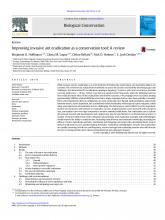
Improving invasive ant eradication as a conservation tool : a review

BRB
Available Online
Hoffman, Benjamin ... et al.
2016
While invasive species eradications are at the forefront of biodiversity conservation, ant eradication failures are common. We reviewed ant eradications worldwide to assess the practice and identify knowledge gaps and challenges. We documented 316 eradication campaigns targeting 11 species, with most occurring in Australia covering small areas (b10 ha). Yellow crazy ant was targeted most frequently, while the bigheaded ant has been eradicated most often. Of the eradications with known outcomes, 144 campaigns were successful, totaling approximately 9500 ha, of which 8300 ha were from a single campaign that has since been partially re-invaded. Three active ingredients, often in combination, are most commonly used: fipronil, hydramethylnon, and juvenile hormone mimics. Active ingredient, bait, and method varied considerablywith respect to species targeted,which made assessing factors of eradication success challenging. We did, however, detect effects by active ingredient, number of treatments, and method on eradication success. Implementation costs increased with treatment area, and median costs were high compared to invasive mammal eradications. Ant eradications are in a phase of increased research and development, and a logical next step for practitioners is to develop best practices. A number of research themes that seek to integrate natural history with eradication strategies and methodologies would improve the ability to eradicate ants: increasing natural history and taxonomic knowledge, increasing the efficacy of active ingredients and baits, minimizing and mitigating non-target risks, developing better tools to declare eradication success, and developing alternative eradication methodologies. Invasive ant eradications are rapidly increasing in both size and frequency, and we envisage that eradicating invasive ants will increase in focus in coming decades given the increasing dispersal and subsequent impacts.