Search the SPREP Catalogue

Refine Search Results

Publication Year

Available Online

Publication Year

Available Online

4 result(s) found.

Sort by

You searched for

Dispositif de suivi de l'abondance et de l'impact du cerf - Fiche finale de capitalisation - PROTEGE
SPREP Publications, Biodiversity Conservation, BRB
Available Online

PROE / SPREP

2025
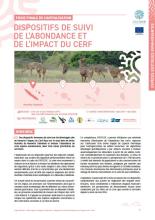
Des dispositifs innovants de suivi ont été développés afin de mesurer l’impact du Cerf Rusa sur le sous-bois de forêts humides de Nouvelle Calédonie et évaluer l’abondance de cette espèce envahissante, dans trois zones prioritaires du territoire. L’élaboration de ces dispositifs poursuit des objectifs complémentaires aux actions de régulation professionnelle mises en œuvre dans le cadre de PROTEGE. Le suivi vise notamment à réaliser un état initial et à évaluer les bénéfices des opérations de régulation, grâce à des outils adaptés à des zones d’intervention difficiles d’accès et caractérisées par une biodiversité exceptionnelle, plus de 80% des espèces végétales des forêts humides d’altitude étant endémiques à la Nouvelle-Calédonie. Un travail initial de sectorisation a permis mieux de caractériser les enjeux, les pressions sur l’environnement ainsi que le contexte socio-économique afin de délimiter les zones d’intervention prioritaires. Pour la première fois en Nouvelle-Calédonie, un protocole standardisé de mesure de l’impact des cerfs a été élaboré. Il s’appuie sur plusieurs indicateurs et prend en compte les spécificités des espèces végétales concernées et des contraintes associées à sa mise en œuvre. En complément, PROTEGE a permis d’élaborer une méthodeinnovante d’évaluation de l’abondance des cerfs, reposant sur l’utilisation d’un drone équipé de capteur thermique pour l’enregistrement de vidéos nocturnes. Un algorithme développé spécifiquement a par ailleurs vocation à réaliser automatiquement les détections à partir de ces vidéos, facilitant considérablement le traitement des données. La mise en œuvre de ce protocole pour la prospection de 4 700 hectares a révélé des densités de populations et des concentrations de hardes localement très élevées, atteignant par endroits des niveaux parmi les plus élevés enregistrés à l’échelle mondiale. Ces résultats fournissent des informations précieuses pour le ciblage de futures interventions et le suivi de leurs bénéfices. FICHE FINALE DE CAPITALISATION DU PROJET PROTEGE, financé par l'Union Européenne.
Pacific Environmental Information Network (PEIN): monitoring report
Biodiversity Conservation
Available Online

Geilfus, Frans

2010
Relevance and quality of design The issues of inadequate resourcing and staffing of libraries and information centres have been identified as a weakness of the development framework that needed be addressed by governments and donors. Weaknesses include the identification and collection of documents, bibliographical registration, staffing and training of libraries and government financial support. The proposal by SPREP to develop a capacity across the member states in the region for an information system on environmental issues was very relevant, given the difficulties of environment institutions and the public in general to access comprehensive and adapted sources of information. The first phase of PEIN {2000-2003} allowed establishing the central library at SPREP headquarters in Apia, but funding was too limited to allow significant capacity building in the countries. The new proposal was intended to develop information databases and hubs across the 14 PACP countries. The final evaluation of PEIN 1 indicated that national libraries were used mostly by school students and barely by professionals; it had also put in doubt the sustainability of the project once external funding would end. An important hypothesis was that libraries and hubs in national environment institutions would obtain strategic government support for operational costs so that material and training provided by the project could be made good use of. This hypothesis was not verified in most countries. libraries retrained at the bottom of priorities in cash strapped Environment Departments, and manned with undertraincd or transient staff. The new project manager put in charge in 2007 was able to adjust the strategy and scale up the use of internet and digital databases, focusing the project on developing a web-based platform easier to manage and accessible to all users in the countries and beyond. The addendum 1 granted no cost extension and the endorsed PEIN 2008 Annual Work Programme and logframe changed the focus towards establishing National Environment Information Centers (NEIC) instead of traditional libraries.