Search the SPREP Catalogue

Refine Search Results

Language

Available Online

Available Online

3 result(s) found.

Sort by

You searched for

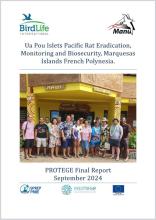
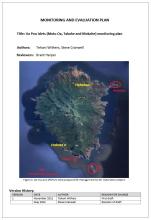
Ua Pou Islets Pacific Rat Eradication - PROTEGE Final Monitoring and Biosecurity Report
SPREP Publications, Biodiversity Conservation, BRB
Available Online

Cranwell, S. (Birdlife International)

,

Withers, T. (SOP Manu)

2024
The Ua Pou islets Pacific rat eradication operation was undertaken in August-September 2023. It attempted a global first of aerially broadcasting rodent bait by drone from a small ship in open sea across the islets of Motu Tākaè, Motu Oa, and Motu Mokohe, at Ua Pou in the Marquesas Islands. The aerial bait application resulted in only two of the three islands having bait successfully applied across their entirety, nonetheless, monitoring 12 months later has confirmed Motu Oa and Motu Tākaè are rat free as is the partially isolated section of Motu Mokohe that was also baited. The eradication success is supported by the establishment of biosecurity knowledge and practices throughout the Ua Pou communities. The results of the seabird and other environmental monitoring will help sustain a commitment over time, as well as benefiting the wider conservation community. The operation demonstrated that drones could be operated off a boat for rodent eradication purposes but was constrained by the consistently strong winds and swell conditions. A larger vessel with a deeper draught is recommended for similar operations in the future and would likely increase the number of flyable days and improve the ease with which take-offs and landings are undertaken by the drone pilots.
Sub-global working group: state of the assessment report, Papua New Guinea - summary national assessment
Available Online

Filer, Colin ... [et al.]

2004
In September 2000, the Millennium Ecosystem Assessment (MA) issued a call for proposals to undertake ‘sub-global’ assessments at local, national, and regional scales. The Call for Proposals was circulated amongst a group of social scientists who had previously had some connection to PNG’s Biodiversity Conservation and Resource Management Program – an initiative which had been funded by the Global Environment Facility from 1993 to 1998. This program had sought to evaluate the actual and potential effectiveness of ‘integrated conservation and development projects’ in forested areas of PNG where high biodiversity values are associated with low population densities. One of the key lessons of the program had been that local communities in these areas are far more interested in ‘development’ than in ‘conservation’, because they can reasonably say that they have been conserving their ecosystems for thousands of years, but are now lagging in their access to modern health and education services because of their small and scattered populations (McCallum and Sekhran 1997; van Helden 1998, 2001; Filer 2004b). If the Government cannot afford to provide these services to remote and thinly populated areas, then local people tend to dream of the day when a logging company or mining company will deliver them from their state of backwardness.