Search the SPREP Catalogue

Refine Search Results

Language

Available Online

Available Online

55 result(s) found.

Sort by

You searched for

An overview of introduced predator management in inhabited landscapes
BRB
Available Online

Russell, James C.

,

Stanley, Margaret C.

2017
Predators play a critical role in ecosystems; however, when overly abundant, they can disrupt natural processes and cause extinctions of species. In particular, oceanic islands have endured many impacts of introduced mammalian predators. Whereas knowledge and management of introduced mammalian predators on islands is well advanced in natural landscapes, in inhabited landscapes, spanning rural and urban environments, comparatively less is known. We summarise key issues from the natural and social sciences in the management of introduced mammalian predators in inhabited landscapes of Aotearoa–New Zealand. We describe the shift in focus over the past few decades from management of introduced mammalian herbivores to predators in rural environments, and the growth in management of introduced mammalian predators in urban environments, both seeking to emulate conservation gains made in forested landscapes. We discuss the circumstances around companion animal management at the interface of the natural and social sciences. We summarise surveys of attitudes towards introduced mammalian predators, the role of biodiversity comanagement between Ma¯ori and Pakeha, and the importance of also considering non-biodiversity benefits from introduced predator management. We describe the rise of community predator control and large landscape projects aspiring for a ‘Predator Free New Zealand’, and how such an aspiration must be concurrent with habitat restoration. We make recommendations for further research on the basic population biology of predators in inhabited landscapes, and more long-term studies. Such studies should be integrated with examination of the motivations for predator management, as well as the biodiversity and social outcomes of such management. We conclude by remarking that introduced predator management is only one component of a robust national strategy for conservation of native biodiversity in New Zealand.
Invasive alien species on islands: impacts, distribution, interactions and management
BRB
Available Online

Holmes, Nick D

,

Meyer, Jean-Yves

,

Pagad, Shyama

,

Russell, James C.

2017
Invasive alien species (IASs) on islands have broad impacts across biodiversity, agriculture, economy, health and culture, which tend to be stronger than on continents. Across small-island developing states (SIDSs), although only a small number of IASs are widely distributed, many more, including those with greatest impact, are found on only a small number of islands. Patterns of island invasion are not consistent across SIDS geographic regions, with differences attributable to correlated patterns in island biogeography and human development. We identify 15 of the most globally prevalent IASs on islands. IAS impacts on islands are exacerbated through interactions with a number of other global change threats, including over-exploitation, agricultural intensification, urban development and climate change. Biosecurity is critical in preventing IAS invasion of islands. Eradication of IASs on islands is possible at early stages of invasion, but otherwise is largely restricted to invasive mammals, or otherwise control is the only option. Future directions in IAS management and research on islands must consider IASs within a broader portfolio of threats to species, ecosystems and people’s livelihoods on islands. We advocate for stronger collaborations among island countries and territories faced with the same IASs in similar socio-ecological environments.
Sustainable livelihood strategies for conservation of biodiversity in Fiji, including potential crops and value adding opportunities in three FPAM project sites - Marketing of suitable products and recommendations; across three project sites: Greater Tomaniivi Protected Areas on Viti Levu, Greater Delaikoro Protected Areas on Vanua Levu, Taveuni Forest Reserve/Ravilevu Nature Reserve on Taveuni.
Biodiversity Conservation
Available Online

Addinsall, Cherise (Dr.)

,

FAO

,

Glencross, Kevin (Dr.)

,

Hancock, Wayne (Dr.)

,

Kete, Tevita

,

Prasad, Vinesh

2017
Conservation of biodiversity, improving rural livelihoods and supporting sustainable agriculture are key issues globally, but for many Pacific Island Countries (PICs) key biodiversity reserves are under considerable pressure from clearing and degradation. Rural communities are often put in a situation where clearing of forest margins is undertaken to meet demand for arable land to produce food and generate income. Forest reserves are also degraded by logging, where timber royalties are important in the absence of other sources of income for traditional landowners and communities. Therefore, agroforestry and ecologically based agriculture systems in the forest margins can help to offset reliance on forest degradation and can enhance the buffers around key reserves. Sustainable forest management and ecotourism also need to be maximised to help meet these challenges of generating income whilst maintaining or enhancing biodiversity, conserving soil and water resources.
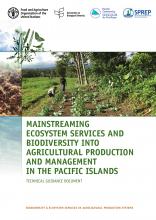
Mainstreaming Ecosystem Services and Biodiversity into Agricultural Production and Management in the Pacific Islands - Technical guidance document
Biodiversity Conservation
Available Online

FAO

2016
The international community is increasingly aware of the link between biodiversity and sustainable development and its direct impact on wealth, health and well-being. Biodiversity is the origin of all crops and domesticated livestock. It is also the source of vital ecosystem services and functions, including soil conservation, water cycling, pollination, pest and disease regulation, carbon sequestration and nitrogen fixation. Biodiversity and the ecosystem services it supports are thus key to nutritional diversity and to agricultural productivity and resilience. The Convention on Biological Diversity (CBD) Strategic Plan for Biodiversity 2011–2020 and its 20 Aichi Biodiversity Targets provide a framework for countries to develop national targets and policies for sustaining biodiversity for a healthy planet. To meet rising global food demands, agricultural systems need to produce greater quantities of more diverse and nutritious food in a sustainable way. This progress can and must be achieved without driving biodiversity loss. It must come through gains in the efficiency of resource use, through sustainable intensification and a landscape perspective in agricultural production. By contributing to the conservation and sustainable use of biodiversity, agriculture will be a key driver for eliminating poverty, improving human health and providing energy, food and clean water for all while maintaining natural ecosystems.