Search the SPREP Catalogue

Refine Search Results

Available Online

Available Online

200 result(s) found.

Sort by

You searched for

  • Author Secretariat of the Pacific Regional Environment Programme (SPREP) (SPREP)
    X
Quantification and magnitude of losses and damages resulting from the impacts of climate change: modelling the transformational impacts and costs of sea level rise in the Caribbean
Climate Change Resilience
Available Online

Simpson, M.C...[et al.]

2010
The inextricable links between climate change and sustainable development have been increasingly recognised over the past decade. In 2007, the Intergovernmental Panel on Climate Change (IPCC)1 concluded with very high confidence that climate change would impede the ability of many nations to achieve sustainable development by mid-century and become a security risk that would steadily intensify, particularly under greater warming scenarios. Article 4.8 of the United Nations Framework Convention on Climate Change (UNFCCC) lists several groups of countries that merit particular consideration for assistance to adapt to climate change “especially: (a) small island countries, (b) countries with low-lying coastal areas, c) countries with areas prone to natural disasters.” Small Island Developing States (SIDS) have characteristics which make them particularly vulnerable to the effects of climate change, sea level rise (SLR) and extreme events, including: relative isolation, small land masses, concentrations of population and infrastructure in coastal areas, limited economic base and dependency on natural resources, combined with limited financial, technical and institutional capacity for adaptation.2
An overview of modeling climate change : impacts in the Caribbean region with contribution from the Pacific Islands, United Nations Development Programme (UNDP), Barbados, West Indies
Climate Change Resilience, Biodiversity Conservation
Available Online

Simpson, M.C...[et al.]

2009
The nations of CARICOM16 in the Caribbean together with Pacific island countries contribute less than 1% to global greenhouse gas (GHG) emissions (approx. 0.33%17 and 0.03%18 respectively), yet these countries are expected to be among the earliest and most impacted by climate change in the coming decades and are least able to adapt to climate change impacts. These nations’ relative isolation, small land masses, their concentrations of population and infrastructure in coastal areas, limited economic base and dependency on natural resources, combined with limited financial, technical and institutional capacity all exacerbates their vulnerability to extreme events and climate change impacts. Stabilising global GHG emissions and obtaining greater support for adaptation strategies are fundamental priorities for the Caribbean Basin and Pacific island countries. CARICOM leaders recently unveiled their collective position that global warming should be held to no more than 1.5°C19 and continue to develop a Climate Change Strategic Plan. The Pacific island countries have expressed their priorities for addressing climate change regionally through the Pacific Leaders’ Call to Action on Climate Change20 and the Pacific Islands Framework for Action on Climate Change 2006-2015.21
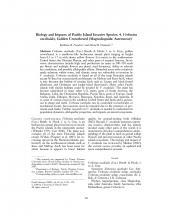
Biology and impacts of Pacific Island Invasive species 4. Verbesina encelioides, Golden Crownbeard (Magnoliopsida: Asteraceae)
Biodiversity Conservation, BRB
Available Online

Clements, David R.

,

Feenstra, Kathleen R.

2008
Verbesina encelioides (Cav.) Benth. & Hook. f. ex A. Gray, golden crownbeard, is a sunflower-like herbaceous annual plant ranging in height from 0.3 to 1.7 m with showy yellow flowers. It is native to the southwestern United States, the Mexican Plateau, and other parts of tropical America. Its invasive characteristics include high seed production (as many as 300-350 seeds per flower and multiple flowers per plant), seed dormancy, ability to tolerate dry conditions, and possible allelopathic effects. Disturbed areas with a relatively sandy substrate within warm, arid climate zones are vulnerable to invasion by V. encelioides. Veresina encelioides is found on all of the main Hawaiian islands except Ni'ihau but is particularly problematic on Midway and Kure Atoll, where it may threaten the habitat of nesting birds such as Laysan and black-footed albatrosses and Christmas and wedge-tailed shearwaters. Many other Pacific islands with similar habitats could be invaded by the V. encelioides. The plant has become naturalised in many other U.S. states, parts of South America, the Bahamas, Cuba, the Dominican Republic Puerto Rico, parts of Europe, Saudi Arabia, India, Ethiopia, Morocco, Botswana, Namibia, Israel, and Australia. It is a pest of various crops in the southern United States and India and is poisonous to sheep and cattle. Verbesina encelioides can be controlled via herbicides or mechanical means, but measures must be repeated due to the presence of persistent seed banks. Further research on V. encelioides is needed to understand its population dynamics, allelopathic properties, and impacts on natural ecosystems.