Search the SPREP Catalogue

Refine Search Results

Related Countries

Language

Available Online

Related Countries

Available Online

14 result(s) found.

Sort by

You searched for

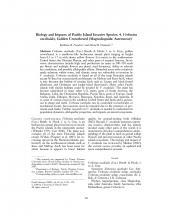
Biology and impacts of Pacific Island Invasive species 4. Verbesina encelioides, Golden Crownbeard (Magnoliopsida: Asteraceae)
Biodiversity Conservation, BRB
Available Online

Clements, David R.

,

Feenstra, Kathleen R.

2008
Verbesina encelioides (Cav.) Benth. & Hook. f. ex A. Gray, golden crownbeard, is a sunflower-like herbaceous annual plant ranging in height from 0.3 to 1.7 m with showy yellow flowers. It is native to the southwestern United States, the Mexican Plateau, and other parts of tropical America. Its invasive characteristics include high seed production (as many as 300-350 seeds per flower and multiple flowers per plant), seed dormancy, ability to tolerate dry conditions, and possible allelopathic effects. Disturbed areas with a relatively sandy substrate within warm, arid climate zones are vulnerable to invasion by V. encelioides. Veresina encelioides is found on all of the main Hawaiian islands except Ni'ihau but is particularly problematic on Midway and Kure Atoll, where it may threaten the habitat of nesting birds such as Laysan and black-footed albatrosses and Christmas and wedge-tailed shearwaters. Many other Pacific islands with similar habitats could be invaded by the V. encelioides. The plant has become naturalised in many other U.S. states, parts of South America, the Bahamas, Cuba, the Dominican Republic Puerto Rico, parts of Europe, Saudi Arabia, India, Ethiopia, Morocco, Botswana, Namibia, Israel, and Australia. It is a pest of various crops in the southern United States and India and is poisonous to sheep and cattle. Verbesina encelioides can be controlled via herbicides or mechanical means, but measures must be repeated due to the presence of persistent seed banks. Further research on V. encelioides is needed to understand its population dynamics, allelopathic properties, and impacts on natural ecosystems.
Samoan Environment Forum: proceedings of the 2005 National Environment Forum|The fact-or-myth of Samoan cultural heritage: personal reflections on family oral history / Tu'u'u Ieti Taule'alo|Samoan and Japan: concerns over mangroves development / Juliet Boon-Nanai|Status of hawksbill turtle nesting in Samoa, 2003/2004 / Mauigoa Lui Bell, Malama S. Momoemausu, Juney Ward & Malaki Iakopo|Participatory approaches for environmental initiatives - community consultation in Samoa / Natalie Mitchell|Emotional intelligence, management concept: a contributing factor for effective service delivery / Mulipola Ausetalia Titimaea|Tropical cyclone forecasting: theory and practical application - case study of tropical cyclone Olaf 2005 / Sala Sagato Tuiafiso|Samoa and the World Heritage Convention - is Samoa ready for world heritage listing / Tuiolo Schuster|Exploring the status of tsunami early warning systems in Samoa / Shaun P. Williams & Aliimalemanu F.M. Leavasa|Determination of a mean daily discharge values for Faleaseela River: implications for population water demand / Masina Nagau Chun, Iosefatu Eti & Mulipola A. Titimaea
Available Online

MNRE

2006
The community based conservation (CBC)paradigm predicts that sustainable biodiversity can only be achieved if local people perceive benefits from conservation. Through interviews, the situation in Samoa portrays that the CBC of mangroves was received with apprehension because the mangrove biodiversity was more significant than sustaining the livelihood of the local communities. In contrast, Iriomote Island residents were able to achieve maximum socio-economic benefits but to the extent that they were over commercializing the mangrove ecosystem. More research is imperative to find out how biodiversity conservation can be married with sustainable development objectives to sustain the local communities' livelihood.