Search the SPREP Catalogue

Refine Search Results

Available Online

Available Online

177 result(s) found.

Sort by

You searched for

  • Author PACC
    X
  • Author Asian Development Bank
    X
Sustainable livelihood strategies for conservation of biodiversity in Fiji, including potential crops and value adding opportunities in three FPAM project sites - Marketing of suitable products and recommendations; across three project sites: Greater Tomaniivi Protected Areas on Viti Levu, Greater Delaikoro Protected Areas on Vanua Levu, Taveuni Forest Reserve/Ravilevu Nature Reserve on Taveuni.
Biodiversity Conservation
Available Online

Addinsall, Cherise (Dr.)

,

FAO

,

Glencross, Kevin (Dr.)

,

Hancock, Wayne (Dr.)

,

Kete, Tevita

,

Prasad, Vinesh

2017
Conservation of biodiversity, improving rural livelihoods and supporting sustainable agriculture are key issues globally, but for many Pacific Island Countries (PICs) key biodiversity reserves are under considerable pressure from clearing and degradation. Rural communities are often put in a situation where clearing of forest margins is undertaken to meet demand for arable land to produce food and generate income. Forest reserves are also degraded by logging, where timber royalties are important in the absence of other sources of income for traditional landowners and communities. Therefore, agroforestry and ecologically based agriculture systems in the forest margins can help to offset reliance on forest degradation and can enhance the buffers around key reserves. Sustainable forest management and ecotourism also need to be maximised to help meet these challenges of generating income whilst maintaining or enhancing biodiversity, conserving soil and water resources.
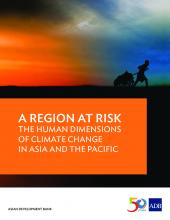
A region at risk - The human dimensions of climate change in Asia and the Pacific
Climate Change Resilience, Biodiversity Conservation
Available Online

Asian Development Bank

2017
The Asia and Pacific region is extremely vulnerable to the impacts of climate change. Unabated warming could significantly undo previous achievements of economic development and improvements of living standards. At the same time, the region has both the economic capacity and weight of influence to change the present fossil-fuel based development pathway and curb global emissions. This report sheds light on the regional implications of the latest projections of changes in climate conditions over Asia and the Pacific. The assessment concludes that, even under the Paris consensus scenario in which global warming is limited to 1.5°C to 2°C above preindustrial levels, some of the land area, ecosystems, and socioeconomic sectors will be significantly affected by climate change impacts, to which policy makers and the investment community need to adapt to. However, under a Business-As-Usual (BAU) scenario, which will cause a global mean temperature rise of over 4°C by the end of this century, the possibilities for adaptation are drastically reduced. Among others, climate change impacts such as the deterioration of the Asian “water towers”, prolonged heat waves, coastal sea-level rise and changes in rainfall patterns could disrupt ecosystem services and lead to severe effects on livelihoods which in turn would affect human health, migration dynamics and the potential for conflicts. This assessment also underlines that, for many areas vital to the region’s economy, research on the effects of climate change is still lacking.