Search the SPREP Catalogue

15 result(s) found.

Sort by

You searched for

  • Collection Biodiversity Conservation
    X
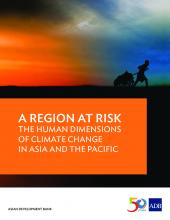
A region at risk - The human dimensions of climate change in Asia and the Pacific
Climate Change Resilience, Biodiversity Conservation
Available Online

Asian Development Bank

2017
The Asia and Pacific region is extremely vulnerable to the impacts of climate change. Unabated warming could significantly undo previous achievements of economic development and improvements of living standards. At the same time, the region has both the economic capacity and weight of influence to change the present fossil-fuel based development pathway and curb global emissions. This report sheds light on the regional implications of the latest projections of changes in climate conditions over Asia and the Pacific. The assessment concludes that, even under the Paris consensus scenario in which global warming is limited to 1.5°C to 2°C above preindustrial levels, some of the land area, ecosystems, and socioeconomic sectors will be significantly affected by climate change impacts, to which policy makers and the investment community need to adapt to. However, under a Business-As-Usual (BAU) scenario, which will cause a global mean temperature rise of over 4°C by the end of this century, the possibilities for adaptation are drastically reduced. Among others, climate change impacts such as the deterioration of the Asian “water towers”, prolonged heat waves, coastal sea-level rise and changes in rainfall patterns could disrupt ecosystem services and lead to severe effects on livelihoods which in turn would affect human health, migration dynamics and the potential for conflicts. This assessment also underlines that, for many areas vital to the region’s economy, research on the effects of climate change is still lacking.
Pacific Environmental Information Network (PEIN): monitoring report
Biodiversity Conservation
Available Online

Geilfus, Frans

2010
Relevance and quality of design The issues of inadequate resourcing and staffing of libraries and information centres have been identified as a weakness of the development framework that needed be addressed by governments and donors. Weaknesses include the identification and collection of documents, bibliographical registration, staffing and training of libraries and government financial support. The proposal by SPREP to develop a capacity across the member states in the region for an information system on environmental issues was very relevant, given the difficulties of environment institutions and the public in general to access comprehensive and adapted sources of information. The first phase of PEIN {2000-2003} allowed establishing the central library at SPREP headquarters in Apia, but funding was too limited to allow significant capacity building in the countries. The new proposal was intended to develop information databases and hubs across the 14 PACP countries. The final evaluation of PEIN 1 indicated that national libraries were used mostly by school students and barely by professionals; it had also put in doubt the sustainability of the project once external funding would end. An important hypothesis was that libraries and hubs in national environment institutions would obtain strategic government support for operational costs so that material and training provided by the project could be made good use of. This hypothesis was not verified in most countries. libraries retrained at the bottom of priorities in cash strapped Environment Departments, and manned with undertraincd or transient staff. The new project manager put in charge in 2007 was able to adjust the strategy and scale up the use of internet and digital databases, focusing the project on developing a web-based platform easier to manage and accessible to all users in the countries and beyond. The addendum 1 granted no cost extension and the endorsed PEIN 2008 Annual Work Programme and logframe changed the focus towards establishing National Environment Information Centers (NEIC) instead of traditional libraries.