Search the SPREP Catalogue

Refine Search Results

Language

Available Online

Available Online

88 result(s) found.

Sort by

You searched for

  • Author Asian Development Bank
    X
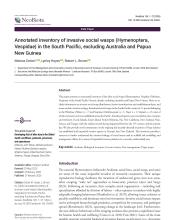
Annotated inventory of invasive social wasps (Hymenoptera, Vespidae) in the South Pacific, excluding Australia and Papua New Guinea
BRB
Available Online

Detoni, Mateus

,

Hayes, Lynley

2026
This paper presents an annotated inventory of the alien social wasps (Hymenoptera: Vespidae: Polistinae, Vespinae) of the South Pacific Oceanic islands, excluding Australia and Papua New Guinea. Here we include information on invasive social wasp distribution, known introductions and establishment dates, and notes on their invasive ecology. Introduced social wasps in the South Pacific consist of 11 species belonging to the Polistinae (Polistes: n = 7) and Vespinae (Dolichovespula: n = 1; Vespa: n = 1; Vespula: n = 2), nine of which are known to have established across the Pacific. Introduced species were recorded in nine countries and territories (Cook Islands, Easter Island, French Polynesia, Fiji, New Caledonia, New Zealand, Niue, Samoa, and Tonga), with the earliest records having happened between the 19th century and the present day. We also provide novel commentary on the ongoing and recently detected incursion of Vespa velutina (an established and impactful invasive species in Europe) into New Zealand. This inventory provides a resource to further understand the invasion biology of social insects and to scaffold risk modelling and management efforts for a taxon of impactful invasive predators in a severely understudied area.
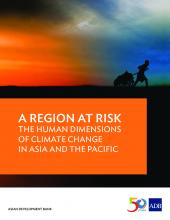
A region at risk - The human dimensions of climate change in Asia and the Pacific
Climate Change Resilience, Biodiversity Conservation
Available Online

Asian Development Bank

2017
The Asia and Pacific region is extremely vulnerable to the impacts of climate change. Unabated warming could significantly undo previous achievements of economic development and improvements of living standards. At the same time, the region has both the economic capacity and weight of influence to change the present fossil-fuel based development pathway and curb global emissions. This report sheds light on the regional implications of the latest projections of changes in climate conditions over Asia and the Pacific. The assessment concludes that, even under the Paris consensus scenario in which global warming is limited to 1.5°C to 2°C above preindustrial levels, some of the land area, ecosystems, and socioeconomic sectors will be significantly affected by climate change impacts, to which policy makers and the investment community need to adapt to. However, under a Business-As-Usual (BAU) scenario, which will cause a global mean temperature rise of over 4°C by the end of this century, the possibilities for adaptation are drastically reduced. Among others, climate change impacts such as the deterioration of the Asian “water towers”, prolonged heat waves, coastal sea-level rise and changes in rainfall patterns could disrupt ecosystem services and lead to severe effects on livelihoods which in turn would affect human health, migration dynamics and the potential for conflicts. This assessment also underlines that, for many areas vital to the region’s economy, research on the effects of climate change is still lacking.