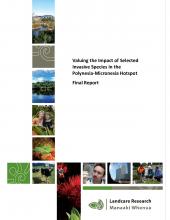
Valuing the impact of selected invasive species in the Polynesia-Micronesia hotspot, final report

BRB
Available Online
Aalbersberg, Bill
,
Boudjelas, Souad
,
Brown, Pike
,
Daigneault, Adam
,
Greenhalgh, Suzie
,
Mather, John
,
Nagle, William
2013
Invasive species pose an enormous threat in the Pacific: not only do they strongly affect biodiversity, but they also potentially affect the economic, social, and cultural wellbeing of Pacific peoples. Invasive species can potentially be managed and that their impacts can potentially be avoided, eliminated, or reduced. However, neither the costs nor the numerous benefits of management are well understood in the Pacific. Thus, the goals of this project were: A) to account for both the costs and benefits of managing invasive species; B) to prepare empirically grounded advocacy materials to help increase investment in the management of invasive species; C) to help governments prioritise investment in managing these species; and D) to build capability for undertaking economic assessments in the future. To accomplish these goals, we undertook cost-benefit analyses (CBAs) of managing five species that are well established on Viti Levu, Fiji: spathodea campanulata (African tulip tree), herpestus javanicus (small Asian mongoose), papuana uninodis (taro beetle), pycnonotus cafer (red-vented bulbul), and merremia peltata (merremia vine). Next, we conducted a comprehensive training programme on the CBA for invasive species management for professionals from the Pacific. Third, we collaborated with Pacific organisations to develop a uniform guide to conducting CBAs with numerous examples from the region. We also designed a flexible Microsoft Excel-based tool for conducting CBAs, enabling professionals who did not attend the training course to nevertheless undertake rigorous CBAs on invasive spsecies management. Finally, we developed advocacy material and publicised findings from this project to promote investment in invasive species management. This report details these activities in turn. It also includes numerous appendices that include the tools, guidance documents, and advocacy materials developed under this project.