Search the SPREP Catalogue

Refine Search Results

Language

Available Online

Available Online

15 result(s) found.

Sort by

You searched for

  • Collection Biodiversity Conservation
    X
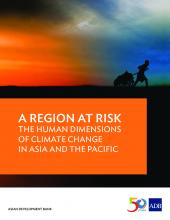
A region at risk - The human dimensions of climate change in Asia and the Pacific
Climate Change Resilience, Biodiversity Conservation
Available Online

Asian Development Bank

2017
The Asia and Pacific region is extremely vulnerable to the impacts of climate change. Unabated warming could significantly undo previous achievements of economic development and improvements of living standards. At the same time, the region has both the economic capacity and weight of influence to change the present fossil-fuel based development pathway and curb global emissions. This report sheds light on the regional implications of the latest projections of changes in climate conditions over Asia and the Pacific. The assessment concludes that, even under the Paris consensus scenario in which global warming is limited to 1.5°C to 2°C above preindustrial levels, some of the land area, ecosystems, and socioeconomic sectors will be significantly affected by climate change impacts, to which policy makers and the investment community need to adapt to. However, under a Business-As-Usual (BAU) scenario, which will cause a global mean temperature rise of over 4°C by the end of this century, the possibilities for adaptation are drastically reduced. Among others, climate change impacts such as the deterioration of the Asian “water towers”, prolonged heat waves, coastal sea-level rise and changes in rainfall patterns could disrupt ecosystem services and lead to severe effects on livelihoods which in turn would affect human health, migration dynamics and the potential for conflicts. This assessment also underlines that, for many areas vital to the region’s economy, research on the effects of climate change is still lacking.
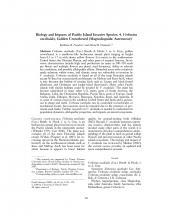
Biology and impacts of Pacific Island Invasive species 4. Verbesina encelioides, Golden Crownbeard (Magnoliopsida: Asteraceae)
Biodiversity Conservation, BRB
Available Online

Clements, David R.

,

Feenstra, Kathleen R.

2008
Verbesina encelioides (Cav.) Benth. & Hook. f. ex A. Gray, golden crownbeard, is a sunflower-like herbaceous annual plant ranging in height from 0.3 to 1.7 m with showy yellow flowers. It is native to the southwestern United States, the Mexican Plateau, and other parts of tropical America. Its invasive characteristics include high seed production (as many as 300-350 seeds per flower and multiple flowers per plant), seed dormancy, ability to tolerate dry conditions, and possible allelopathic effects. Disturbed areas with a relatively sandy substrate within warm, arid climate zones are vulnerable to invasion by V. encelioides. Veresina encelioides is found on all of the main Hawaiian islands except Ni'ihau but is particularly problematic on Midway and Kure Atoll, where it may threaten the habitat of nesting birds such as Laysan and black-footed albatrosses and Christmas and wedge-tailed shearwaters. Many other Pacific islands with similar habitats could be invaded by the V. encelioides. The plant has become naturalised in many other U.S. states, parts of South America, the Bahamas, Cuba, the Dominican Republic Puerto Rico, parts of Europe, Saudi Arabia, India, Ethiopia, Morocco, Botswana, Namibia, Israel, and Australia. It is a pest of various crops in the southern United States and India and is poisonous to sheep and cattle. Verbesina encelioides can be controlled via herbicides or mechanical means, but measures must be repeated due to the presence of persistent seed banks. Further research on V. encelioides is needed to understand its population dynamics, allelopathic properties, and impacts on natural ecosystems.