Search the SPREP Catalogue

Refine Search Results

Available Online

Available Online

87 result(s) found.

Sort by

You searched for

  • Author Asian Development Bank
    X
Plan de sensibilisation aux espèces exotiques envahissantes et à l'importance de la conservation de la flore patrimoniale du "Paysage Culturel Taputapuatea"
Biodiversity Conservation, BRB
Available Online

Chanseau, Reynald

,

Jacq, Fred

,

Laberneze, Gilles

,

Languille, Juliette

2021
La mise en œuvre du projet PROTEGE sur la thématique des EEE sur le Paysage Culturel Taputapuatea ne peut être garantie sans un appui en termes de sensibilisation et de communication. En effet, cela permettra une meilleure appropriation des actions de mise en œuvre de la gestion et de la restauration du site UNESCO par la population locale, et cela permettra également aux acteurs locaux de mieux agir sur cette thématique et de faire évoluer les pratiques à court, moyen et long terme afin de garantir l’intégrité du Bien et la reconduction du label UNESCO. La mission de sensibilisation va permettre d’informer les acteurs locaux sur les généralités des EEE et leurs moyens de lutte/éradication associés, et sur les EVP et leur conservation et restauration. Elle passera par des phases d’information, de connaissances, et d’actions pédagogiques, ludiques avec des visites et ateliers de terrain. L’élaboration du plan de sensibilisation place au cœur de sa stratégie des publics cibles auxquels sont associés : des objectifs et messages de sensibilisation, des moyens, et des outils/supports adéquats et adaptés aux publics cibles.
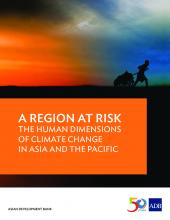
A region at risk - The human dimensions of climate change in Asia and the Pacific
Climate Change Resilience, Biodiversity Conservation
Available Online

Asian Development Bank

2017
The Asia and Pacific region is extremely vulnerable to the impacts of climate change. Unabated warming could significantly undo previous achievements of economic development and improvements of living standards. At the same time, the region has both the economic capacity and weight of influence to change the present fossil-fuel based development pathway and curb global emissions. This report sheds light on the regional implications of the latest projections of changes in climate conditions over Asia and the Pacific. The assessment concludes that, even under the Paris consensus scenario in which global warming is limited to 1.5°C to 2°C above preindustrial levels, some of the land area, ecosystems, and socioeconomic sectors will be significantly affected by climate change impacts, to which policy makers and the investment community need to adapt to. However, under a Business-As-Usual (BAU) scenario, which will cause a global mean temperature rise of over 4°C by the end of this century, the possibilities for adaptation are drastically reduced. Among others, climate change impacts such as the deterioration of the Asian “water towers”, prolonged heat waves, coastal sea-level rise and changes in rainfall patterns could disrupt ecosystem services and lead to severe effects on livelihoods which in turn would affect human health, migration dynamics and the potential for conflicts. This assessment also underlines that, for many areas vital to the region’s economy, research on the effects of climate change is still lacking.
Special Issue Article: Tropical rat eradicationBest practice guidelines for rat eradication on tropical islands. Biological Conservation. Volume 185, May 2015
Biodiversity Conservation, BRB
Available Online

Boudjelas. S

,

Broome. K

,

Cranwell. S

,

Griffiths. R

,

Keitt. B

,

Millett. J

,

Pitt. W

,

Samaniego-Herrera. A.

2015
Invasive vertebrates are a leading cause of the extinction on islands and rats (Rattus spp.) are one of the most damaging to island ecosystems. Methods to eradicate rates from islands are well established and there have been over 580 successful eradications to date. Increasingly, rat eradications are being implemented on tropical islands, a reflection of the need to protect the threatened biodiversity in the tropics. Yet rat eradications on tropical islands fail more frequently than those in temperate climates. In an effort to identify the main reasons for the lower success rate on tropical islands and possible solutions, a workshop was convened with the 34 experts in rat eradication, tropical rodent and island ecology and toxicology. The workshop focused on projects using aerial broadcast of brodifacoum, a 2nd generation anticoagulant, because this approach had provided the highest success rate for eradicating rodents from islands. The workshop participants reviewed previously identified challenges to successful rat eradications on tropical islands including increased insect and crab densities resulting in competition for bait, year round or unpredictable timing of breeding rats and increased or unpredictable availability of alternative, natural foods. They also identified a number of new, likely reasons for the lower success rate on tropical islands and provided recommendations for how to address these risks in the planning and implementation of rat eradications. While the success rate of aerial broadcast rat eradications in tropical environments is quite high at 89%, it is hoped that by following the recommended best practices provided in this paper, future success rates will be closer to the 96.5% demonstrated for aerial broadcast rat eradication on temperate islands.