Search the SPREP Catalogue

Refine Search Results

Available Online

Available Online

97 result(s) found.

Sort by

You searched for

  • Author Asian Development Bank
    X
Liste Préventive des Espèces Exotiques Envahissantes de Wallis et Futuna - Plan d'intervention rapide et fiches techniques des espèces
Biodiversity Conservation, BRB
Available Online

Bioconsulting

,

Service Territorial de l'Environnement de Wallis et Futuna

2024
La liste préventive des espèces exotiques envahissantes de Wallis et Futuna a été créée en 2024 par une révision de la règlementation, à la suite d'une prestation d’une biologiste, et de la consultation d’associations et de services du territoire. Elle répertorie 123 espèces absentes du territoire mais présentes dans la région et dont Wallis et Futuna entend se préserver. Le document compile des fiches techniques de reconnaissance et de gestion des 123 espèces figurant sur la liste préventive, relatives aux milieux terrestres, humides et de rivières et marins. Le document détaille également les 6 étapes du plan d'intervention rapide élaboré pour répondre aux introductions d'espèces exotiques envahissantes à Wallis et Futuna : (i) réceptionner le signalement, et collecter les informations; (ii) confirmer l'identification de l'espèce; (iii) améliorer la connaissance sur la répartition de l'espèce; (iv) évaluer la situation et choisir l'option de gestion; (v) élaborer et mettre en place un plan d'intervention et (vi) veiller.
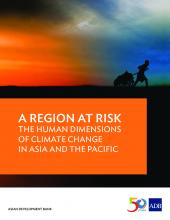
A region at risk - The human dimensions of climate change in Asia and the Pacific
Climate Change Resilience, Biodiversity Conservation
Available Online

Asian Development Bank

2017
The Asia and Pacific region is extremely vulnerable to the impacts of climate change. Unabated warming could significantly undo previous achievements of economic development and improvements of living standards. At the same time, the region has both the economic capacity and weight of influence to change the present fossil-fuel based development pathway and curb global emissions. This report sheds light on the regional implications of the latest projections of changes in climate conditions over Asia and the Pacific. The assessment concludes that, even under the Paris consensus scenario in which global warming is limited to 1.5°C to 2°C above preindustrial levels, some of the land area, ecosystems, and socioeconomic sectors will be significantly affected by climate change impacts, to which policy makers and the investment community need to adapt to. However, under a Business-As-Usual (BAU) scenario, which will cause a global mean temperature rise of over 4°C by the end of this century, the possibilities for adaptation are drastically reduced. Among others, climate change impacts such as the deterioration of the Asian “water towers”, prolonged heat waves, coastal sea-level rise and changes in rainfall patterns could disrupt ecosystem services and lead to severe effects on livelihoods which in turn would affect human health, migration dynamics and the potential for conflicts. This assessment also underlines that, for many areas vital to the region’s economy, research on the effects of climate change is still lacking.
Journal of South Pacific Law : Special Issue - Human Rights and Climate Change Law
Climate Change Resilience
Available Online

Aonima, C. & Kumar, S.

,

Bustreo, F.

,

Doebbler, C.

,

Fa'anunu, F.

,

USP

,

Wewerinke, M. & Fa'anunu, F.

2015
Climate change is often referred to as the defining challenge of our time, and it is well known that Pacific Island States are particularly vulnerable to the adverse effects of climate change. Indeed, these adverse effects are already very tangible for most communities across the region. Coastal features are visibly changing, with rising sea-levels, higher king tides and storm surges, saltwater intrusion and changing weather patterns posing an increasing threat to the livelihoods of Pacific Island communities. The threats are amplified by extreme weather events becoming more intense and more damaging as a result of climate change, with Cyclone Pam recently causing loss of human life and catastrophic damage in Vanuatu, and to a lesser extent in the Solomon Islands, Tuvalu and Kiribati. 2 While communities and governments—assisted by regional, international and nongovernmental organizations—are proactively building resilience and adapting to climate change, there is a real risk of much more severe and damaging impacts materializing in the coming decades.3 The threats are so severe that most, if not all, Pacific Island States face the threat of losing some or all of their habitable territory as a result of climate change, with related risks of the loss of traditional livelihoods and large-scale involuntary displacement