Search the SPREP Catalogue

Refine Search Results

Available Online

Available Online

88 result(s) found.

Sort by

You searched for

  • Author Asian Development Bank
    X
Liste Préventive des Espèces Exotiques Envahissantes de Wallis et Futuna - Plan d'intervention rapide et fiches techniques des espèces
Biodiversity Conservation, BRB
Available Online

Bioconsulting

,

Service Territorial de l'Environnement de Wallis et Futuna

2024
La liste préventive des espèces exotiques envahissantes de Wallis et Futuna a été créée en 2024 par une révision de la règlementation, à la suite d'une prestation d’une biologiste, et de la consultation d’associations et de services du territoire. Elle répertorie 123 espèces absentes du territoire mais présentes dans la région et dont Wallis et Futuna entend se préserver. Le document compile des fiches techniques de reconnaissance et de gestion des 123 espèces figurant sur la liste préventive, relatives aux milieux terrestres, humides et de rivières et marins. Le document détaille également les 6 étapes du plan d'intervention rapide élaboré pour répondre aux introductions d'espèces exotiques envahissantes à Wallis et Futuna : (i) réceptionner le signalement, et collecter les informations; (ii) confirmer l'identification de l'espèce; (iii) améliorer la connaissance sur la répartition de l'espèce; (iv) évaluer la situation et choisir l'option de gestion; (v) élaborer et mettre en place un plan d'intervention et (vi) veiller.
A potential new tool for the toolbox: assessing gene drives for eradicating invasive rodent populations
Biodiversity Conservation, BRB
Available Online

Brown, P.R.

,

Campbell, K.J.

,

Delborne, J.

,

Godwin, J.

,

Gould, F.

,

Howald, G.R.

,

Kanavy, D.M.

,

Kuiken, T.

,

Packard, H.

,

Piaggio, A.

,

Saah, J.R.

,

Serr, M.

,

Shiels, A.

,

Thomas, P.

,

Threadgill, D.

,

Tompkins, D.M.

2019
Invasive rodents have significant negative impacts on island biodiversity. All but the smallest of rodent eradications currently rely on island-wide rodenticide applications. Although significant advances have been made in mitigating unintended impacts, rodent eradication on inhabited islands remains extremely challenging. Current tools restrict eradication efforts to fewer than 15% of islands with critically endangered or endangered species threatened by invasive rodents. The Genetic Biocontrol of Invasive Rodents partnership is an interdisciplinary collaboration to develop and evaluate gene drive technology for eradicating invasive rodent populations on islands. Technological approaches currently being investigated include the production of multiple strains of Mus musculus with a modified form of the native t-complex, or a CRISPR gene drive, carrying genes or mechanisms that determine sex. These systems have the potential to skew the sex ratio of off spring to approach 100% single-sex, which could result in population collapse. One goal proposed is to test the ability of constructs to spread and increase in frequency in M. musculus populations in biosecure, captive settings and undertake modelling to inform development and potential deployment of these systems. Structured ecologically-based risk assessments are proposed, along with social and cultural engagement to assess the acceptability of releasing a gene drive system. Work will be guided by an external ethics advisory board. Partners are from three countries with significant regulatory capacity (USA, Australia, New Zealand). Thus, we will seek data sharing agreements so that results from experiments may be used within all three countries and treat regulatory requirements as a minimum. Species-specific, scalable, and socially acceptable new eradication tools could produce substantial biodiversity benefits not possible with current technologies. Gene drive innovation may provide such a tool for invasive species management and be potentially transformative and worthy of exploring in an inclusive, responsible, and ethical manner.
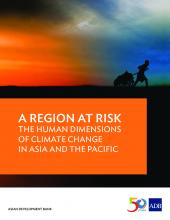
A region at risk - The human dimensions of climate change in Asia and the Pacific
Climate Change Resilience, Biodiversity Conservation
Available Online

Asian Development Bank

2017
The Asia and Pacific region is extremely vulnerable to the impacts of climate change. Unabated warming could significantly undo previous achievements of economic development and improvements of living standards. At the same time, the region has both the economic capacity and weight of influence to change the present fossil-fuel based development pathway and curb global emissions. This report sheds light on the regional implications of the latest projections of changes in climate conditions over Asia and the Pacific. The assessment concludes that, even under the Paris consensus scenario in which global warming is limited to 1.5°C to 2°C above preindustrial levels, some of the land area, ecosystems, and socioeconomic sectors will be significantly affected by climate change impacts, to which policy makers and the investment community need to adapt to. However, under a Business-As-Usual (BAU) scenario, which will cause a global mean temperature rise of over 4°C by the end of this century, the possibilities for adaptation are drastically reduced. Among others, climate change impacts such as the deterioration of the Asian “water towers”, prolonged heat waves, coastal sea-level rise and changes in rainfall patterns could disrupt ecosystem services and lead to severe effects on livelihoods which in turn would affect human health, migration dynamics and the potential for conflicts. This assessment also underlines that, for many areas vital to the region’s economy, research on the effects of climate change is still lacking.