Search the SPREP Catalogue

Refine Search Results

Language

Available Online

Available Online

87 result(s) found.

Sort by

You searched for

  • Author Asian Development Bank
    X
Climate change and community resilience in Samoa
Climate Change Resilience
Available Online

Binns, Tony

,

Latai‐Niusulu, Anita

,

Nel, Etienne

2019
Being resilent in the face of climate change seems especially important for island societies, which face the effects of rising temperatures, unpredictable rainfall, changing wind patterns and sea level rise. To date, most studies of adaptation and resilience among Pacific island communities have used indicators and methods rooted in Western science and neo-classical economics. These have been criticized as being locally irrelevant and inadequate to appreciate the dynamic nature and social structures of island communities and their capacity to adapt. This paper challenges the paradigm that defines resilience as a return to equilibrium, by using a non-equilibrium, cultural ecological lens. The non-equilibrium view of resilience sees the social systems of island nations as highly dynamic and undergoing persistent adaptation in the face of changing environmental factors. Field-based research undertaken in eight villages in Samoa found that , through constant exposure to environmental change over extended periods of time, communities have become resilient and are in a position to adapt to future changes. In developing future policy in relation to climate change, Pacific island government need to develop a more nuanced understanding of islanders' perceptions and historical actions in the context of both their physical locations and their dynamic socio-cultural systems
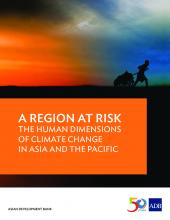
A region at risk - The human dimensions of climate change in Asia and the Pacific
Climate Change Resilience, Biodiversity Conservation
Available Online

Asian Development Bank

2017
The Asia and Pacific region is extremely vulnerable to the impacts of climate change. Unabated warming could significantly undo previous achievements of economic development and improvements of living standards. At the same time, the region has both the economic capacity and weight of influence to change the present fossil-fuel based development pathway and curb global emissions. This report sheds light on the regional implications of the latest projections of changes in climate conditions over Asia and the Pacific. The assessment concludes that, even under the Paris consensus scenario in which global warming is limited to 1.5°C to 2°C above preindustrial levels, some of the land area, ecosystems, and socioeconomic sectors will be significantly affected by climate change impacts, to which policy makers and the investment community need to adapt to. However, under a Business-As-Usual (BAU) scenario, which will cause a global mean temperature rise of over 4°C by the end of this century, the possibilities for adaptation are drastically reduced. Among others, climate change impacts such as the deterioration of the Asian “water towers”, prolonged heat waves, coastal sea-level rise and changes in rainfall patterns could disrupt ecosystem services and lead to severe effects on livelihoods which in turn would affect human health, migration dynamics and the potential for conflicts. This assessment also underlines that, for many areas vital to the region’s economy, research on the effects of climate change is still lacking.