Search the SPREP Catalogue

Refine Search Results

Language

Available Online

Available Online

86 result(s) found.

Sort by

You searched for

  • Author Asian Development Bank
    X
Rural women and food security in Asia and the Pacific: Prospects and paradoxes
BRB
Available Online

Balakrishnan, Revathi

,

Fairbairn-Dunlop, Peggy

2005
Agriculture and food production offer stable livelihood options to rural communities throughout Asia and the Pacific region. Even as the effects of globalization spread in the region, farm production – most often at the smallholder level – continues to be a family enterprise. A fair share of farmers in the region engages in subsistence farming and poverty is a common occurrence among them. Farm enterprises are mostly managed by family members and family labour is a critical asset and often the only reliable investment. As rural women and men toil to preserve their heritage and broaden their economic choices, their endeavours are made more difficult by a lack of resources and market fluctuations. Asian and Pacific farmers, both men and women, are guardians of biodiversity, household food security and providers of food to urban communities. In these small farm enterprises distinct gender roles and gender differentiated access to technology and resources are evident. This disparity is compounded by the neglect of investment in rural social infrastructures such as education, health care and communications. In such resource poor rural environments, the struggle by rural women for access to resources and services is inevitable. In many Asian and Pacific countries, substantial gender equality gains have been made in urban areas in education, health and employment. Yet rural women lag behind. Moreover, rural women’s work is multifaceted and demanding both as family workers and agricultural labourers. Social and economic indicators often do not do justice to their contributions. Development innovations such as microcredit and self-help groups promote rural women’s economic development, but emerging evidence suggests that gender equality in rural communities is far from an everyday reality. Persisting social biases and traditional perceptions and assumptions regarding women’s responsibilities and their capacities continue to hamper women’s progress. This publication presents an overview of both the substantial contribution made by rural women to the economies in the region and the persisting barriers to their advancement. The framework of analysis, data and information reviewed together illustrate the complexity of rural women’s work in the region and offer a broad perspective on women’s economic and social contribution as well as on the barriers they encounter in accessing resources.
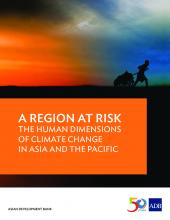
A region at risk - The human dimensions of climate change in Asia and the Pacific
Climate Change Resilience, Biodiversity Conservation
Available Online

Asian Development Bank

2017
The Asia and Pacific region is extremely vulnerable to the impacts of climate change. Unabated warming could significantly undo previous achievements of economic development and improvements of living standards. At the same time, the region has both the economic capacity and weight of influence to change the present fossil-fuel based development pathway and curb global emissions. This report sheds light on the regional implications of the latest projections of changes in climate conditions over Asia and the Pacific. The assessment concludes that, even under the Paris consensus scenario in which global warming is limited to 1.5°C to 2°C above preindustrial levels, some of the land area, ecosystems, and socioeconomic sectors will be significantly affected by climate change impacts, to which policy makers and the investment community need to adapt to. However, under a Business-As-Usual (BAU) scenario, which will cause a global mean temperature rise of over 4°C by the end of this century, the possibilities for adaptation are drastically reduced. Among others, climate change impacts such as the deterioration of the Asian “water towers”, prolonged heat waves, coastal sea-level rise and changes in rainfall patterns could disrupt ecosystem services and lead to severe effects on livelihoods which in turn would affect human health, migration dynamics and the potential for conflicts. This assessment also underlines that, for many areas vital to the region’s economy, research on the effects of climate change is still lacking.