Location
SPREP LIBRARY
Publisher
National University of Samoa
Publication Place
Apia Samoa
Physical Description:
10 p. ; 29 cm
Call Number
VF 6926 [EL]
Language
English
Record ID:
34775
Legacy PEIN ID:
74777
General Notes
Kept in vertical file collection and also available online
Image
Available online
Subject Heading(s)
Mangroves - Protection - Samoa
Environment - Protection - Samoa
Mangroves - Environmental change - Samoa
Protected areas - Management
Abstract
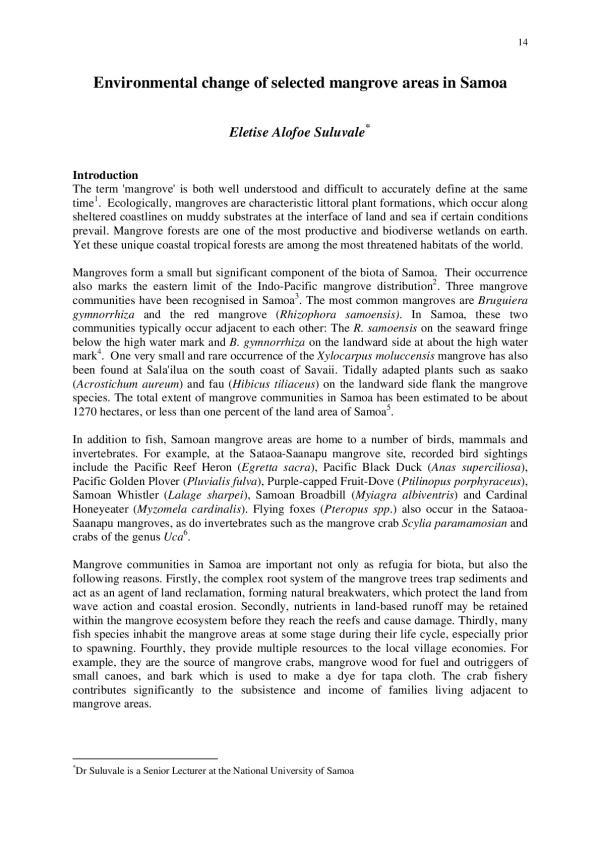
Samoan 14 Environmental change of selected mangrove areas in Samoa Eletise Alofoe Suluvale* Introduction The term 'mangrove' is both well understood and difficult to accurately define at the same time1. Ecologically, mangroves are characteristic littoral plant formations, which occur along sheltered coastlines on muddy substrates at the interface of land and sea if certain conditions prevail. Mangrove forests are one of the most productive and biodiverse wetlands on earth. Yet these unique coastal tropical forests are among the most threatened habitats of the world. Mangroves form a small but significant component of the biota of Samoa. Their occurrence also marks the eastern limit of the Indo-Pacific mangrove distribution2. Three mangrove communities have been recognised in Samoa3. The most common mangroves are Bruguiera gymnorrhiza and the red mangrove (Rhizophora samoensis). In Samoa, these two communities typically occur adjacent to each other: The R. samoensis on the seaward fringe
Location
SPREP LIBRARY
Publisher
National University of Samoa
Publication Place
Apia Samoa
Physical Description:
10 p. ; 29 cm
Call Number
VF 6926 [EL]
Language
English
Record ID:
34775
Legacy PEIN ID:
74777
General Notes
Kept in vertical file collection and also available online
Record Created: 04-Aug-2008
Record Modified: 17-Mar-2025