Search the SPREP Catalogue

Refine Search Results

Tags / Keywords

Available Online

Tags / Keywords

Available Online

1897 result(s) found.

Sort by

You searched for

  • Tags / Keywords climatic changes
    X
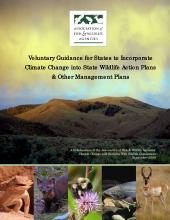
Voluntary guidance for states to incorporate Climate Change into State Wildlife Action Plans & Other Management Plans
Climate Change Resilience, BRB
Available Online

Association of Fish & Wildlife Agencies

,

Climate Change Wildlife Action Plan Work Group

2008
The Climate Change Wildlife Action Plan Guidance Document provides voluntary guidance for state fish and wildlife agencies wanting to better incorporate the impacts of climate change on wildlife and their habitats into Wildlife Action Plans. The approaches and techniques described in this document also will be useful in modifying other wildlife plans (e.g. big game/upland game/migratory bird plans, joint venture implementation plans, national fish habitat action plan, etc.) to address climate change. The document provides an overview of the information currently available on climate change, tools that can be used to plan for and implement climate change adaptation, voluntary guidance and case studies. Climate change is a large and growing threat to all wildlife and natural systems and will also exacerbate many existing threats. Efforts to address climate change should not diminish the immediate need to deal with threats that may be independent of climate change such as habitat loss/fragmentation from development, introduction of invasive species, water pollution and wildlife diseases. Since climate change is a complex and often politically-charged issue, it’s understood that the decision to revise Wildlife Action Plans or other plans to address climate change, rests solely with each state fish and wildlife agency.
High-level conference on world food security: the challenges of climate change and bioenergy: climate change and food security in Pacific Island Countries
Climate Change Resilience, Biodiversity Conservation
Available Online

FAO/USP

,

Secretariat of the Pacific Regional Environment Programme (SPREP)

2008
The overall purpose of this paper is to address food security and poverty reduction in the face of climate change and energy security. It attempts to bring to the fore food security threats associated with climate change in the food production and supply environments, as well as the broader livelihood and ecological changes that will occur as a consequence. Recognizing the different geographical regions around the Pacific and how climate change would impact on their food security situations opens up new opportunities for understanding why changes happen. An attempt will also be made to address how Pacific Islanders can be assisted to enhance their capacity to reduce risk and make optimal use of current climate resources in order to capitalize on benefits that may arise due to the changing climate. In doing so, it will attempt to highlight some of the current impacts of climate change reported by Pacific Island Countries in their national communications to the UNFCCC and their National Adaptation Programmes of Action (NAPAs), and what attempts have been made to seriously address these issues. It is recognized that climate change is an additional stress that needs to be managed by the agricultural and broader development communities but it should also be emphasized that climate change will further exacerbate current development stresses that are already plaguing the agriculture community and national governments. This paper will try to draw out these links and discuss ways to proactively address the situation now rather then later.
Climate change and water: technical paper of the IPCC
Climate Change Resilience, Biodiversity Conservation
Available Online

Bates, Bryson

,

Kundzewicz, Zbigniew

,

Palutikof Jean

,

Wu, Shaohon Wu

2008
Observational records and climate projections provide abundant evidence that freshwater resources are vulnerable and have the potential to be strongly impacted by climate change, with wide-ranging consequences for human societies and ecosystems. Observed warming over several decades has been linked to changes in the large-scale hydrological cycle such as: increasing atmospheric water vapour content; changing precipitation patterns, intensity and extremes; reduced snow cover and widespread melting of ice; and changes in soil moisture and runoff. Precipitation changes show substantial spatial and inter-decadal variability. Over the 20th century, precipitation has mostly increased over land in high northern latitudes, while decreases have dominated from 10°S to 30°N since the 1970s. The frequency of heavy precipitation events (or proportion of total rainfall from heavy falls) has increased over most areas (likely). Globally, the area of land classified as very dry has more than doubled since the 1970s (likely). There have been significant decreases in water storage in mountain glaciers and Northern Hemisphere snow cover. Shifts in the amplitude and timing of runoff in glacier- and snowmelt-fed rivers, and in ice-related phenomena in rivers and lakes, have been observed (high confidence).