Search the SPREP Catalogue

Refine Search Results

Tags / Keywords

Available Online

Tags / Keywords

Available Online

503 result(s) found.

Sort by

You searched for

  • Tags / Keywords problem definition-baseline
    X
Eradicating Pacific rats (Rattus exulans) from Nu'utele and Nu'ulua Islands, Samoa - some of the challenges of operating in the tropcial Pacific
BRB
Available Online

Butler, D.J.

,

Tipamaa, F.T.

,

Tye, A.

,

Wylie, M.

2011
The restoration of the small offshore islands of Nu’utele (108ha) and Nu’ulua (25ha) has long been identified as a priority for biodiversity conservation in Samoa. The first step towards restoration was the aerial spreading of brodifacoum to eradicate Pacific rats (Rattus exulans) in August 2009. Procedures for the eradication followed those used in New Zealand and involved technical experts from that country. Particular challenges included a tight operational time-frame (two months), technical problems magnified by the remote location, variable reliability of weather forecasting,working with the local community, and mitigating rodenticide exposure risks for the friendly ground-dove (Gallicolumba stairi) (IUCN: vulnerable). Solutions to these challenges are discussed as guidance for similar projects in remote island locations. Follow-up monitoring between August 2009 and March 2010 indicated that the eradication had been successful, but Pacific rats were detected on Nu’utele in May 2011. Nu’ulua has yet to be rechecked in 2011. DNA analyses are being organised to determine if these rats are survivors or re-invaders.
Encyclopedia of biological invasions.
Biodiversity Conservation, BRB

Rejmanek, Marcel

,

Simberloff, Dadniel

2011
This encyclopedia illuminates a topic at the forefront of global ecology - biological invasions, or organisms that come to live in the wrong place. Written by leading scientists from around the world, the book addresses all aspects of this subject at a global level - including invasions by animals, plants, fungi, and bacteria - in succinct, alphabetically arranged articles. Scientifically uncompromising, yet clearly written and free of jargon, the volume encompasses fields of study including biology, demography, geography, ecology, evolution, sociology, and natural history and features many cross-references, suggestions for further reading, illustrations, an appendix of the world's worst 100 invasive species, a glossary, and more. The book features articles on well-known invasive species such the zebra mussel, chestnut blight, cheatgrass, gypsy moth, Nile perch, giant African snail, and Norway rat and details regions with especially large numbers of introduced species including the Great Lakes, Mediterranean Sea, Hawaiian Islands, Australia and New Zealand. This work will be of great value in ecology and conservation science. Invasive species are a severe and exponentially growing problem of the environment, and one difficult even to characterize, much less contain.-Edward O. Wilson, author and scientist "Second only to habitat loss mixed with climate disruption, invasive species represent the next most serious threat to biodiversity. The Encyclopedia of Biological Invasions, written by an impressive group of experts, now makes available to conservation biologists, managers, decision makers, and concerned citizens a comprehensive single source of this key topic."-Paul R. Ehrlich, co-author of The Dominant Animal
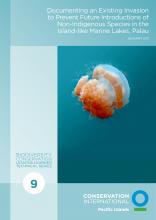
Documenting an existing invasion to prevent future introductions of non-indigenous species in the island-like marine lakes, Koror, Palau
Biodiversity Conservation, BRB
Available Online

Patris, Sharon ... [et al.]

2011
This document is part of a technical report series on conservation projects funded by the Critical Ecosystem Partnership Fund (CEPF) and the Conservation International Pacific Islands Program (CI-Pacific). The main purpose of this series is to disseminate project findings and successes to a broader audience of conservation professionals in the Pacific, along with interested members of the public and students. The reports are being prepared on an ad-hoc basis as projects are completed and written up. In most cases the reports are composed of two parts, the first part is a detailed technical report on the project which gives details on the methodology used, the results and any recommendations. The second part is a brief project completion report written for the donor and focused on conservation impacts and lessons learned. The CEPF fund in the Polynesia-Micronesia region was launched in September 2008 and will be active until 2013. It is being managed as a partnership between CI Pacific and CEPF. The purpose of the fund is to engage and build the capacity of non-governmental organizations to achieve terrestrial conservation. The total grant envelope is approximately US$6 million, and focuses on three main elements: the prevention, control and eradication of invasive species in key biodiversity areas (KBAs); strengthening the conservation status and management of a prioritized set of 60 KBAs and building the awareness and participation of local leaders and community members in the implementation of threatened species recovery plans.