Search the SPREP Catalogue

Refine Search Results

Available Online

Available Online

257 result(s) found.

Sort by

You searched for

  • Subject Reserves - Oceania - Pacific
    X
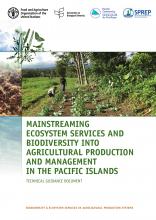
Mainstreaming Ecosystem Services and Biodiversity into Agricultural Production and Management in the Pacific Islands - Technical guidance document
Biodiversity Conservation
Available Online

FAO

2016
The international community is increasingly aware of the link between biodiversity and sustainable development and its direct impact on wealth, health and well-being. Biodiversity is the origin of all crops and domesticated livestock. It is also the source of vital ecosystem services and functions, including soil conservation, water cycling, pollination, pest and disease regulation, carbon sequestration and nitrogen fixation. Biodiversity and the ecosystem services it supports are thus key to nutritional diversity and to agricultural productivity and resilience. The Convention on Biological Diversity (CBD) Strategic Plan for Biodiversity 2011–2020 and its 20 Aichi Biodiversity Targets provide a framework for countries to develop national targets and policies for sustaining biodiversity for a healthy planet. To meet rising global food demands, agricultural systems need to produce greater quantities of more diverse and nutritious food in a sustainable way. This progress can and must be achieved without driving biodiversity loss. It must come through gains in the efficiency of resource use, through sustainable intensification and a landscape perspective in agricultural production. By contributing to the conservation and sustainable use of biodiversity, agriculture will be a key driver for eliminating poverty, improving human health and providing energy, food and clean water for all while maintaining natural ecosystems.
Freshwater ichthyofauna of the Pacific-Asia Biodiversity Transect (PABITRA) Gateway in Viti Levu, Fiji
Biodiversity Conservation

Boseto, David T.

,

Copeland, Lekima K. F.

,

Jenkins, Aaron P.

2016
The freshwater ichthyofauna of the Fiji islands remained poorly documented before the establishment of the Pacific-Asia Biodiversity Transect (PABITRA) network. The PABITRA approach assesses biodiversity along ocean-to-mountain transects and promotes sustainable land use on islands across the Pacific. Multiple surveys of freshwater fish species along the Viti Levu PABITRA transect have contributed six new occurrence records and one new species to the known freshwater fishes of Fiji since 2002. In total, 21 indigenous species of fish (9% endemic) from 10 families and no introduced fishes were found in the three PABITRA sites. Diversity was highest (16 species) at Savura forest reserve and decreased further inland into Sovi and Wabu. The assemblage found is dominated by highly migratory species (95%) that traverse the different aquatic habitats (marine, estuarine, lowland and upland streams) covered by the PABITRA transect. This high degree of connectivity highlights several growing issues affecting aquatic fauna on the high island of Viti Levu. The reduction in forest cover along the gateway transects, especially in the terminal reaches, and infrastructure development such as dams and weirs have deleterious effects on the migration routes of the Fijian ichthyofauna. Several species collected are important food sources and have cultural totemic importance to local inhabitants along the vertical transect. This paper documents the ichthyofauna of the Fiji gateway transect, ecological characteristics of this assemblage, IUCN Redlist conservation assessment status and highlights factors affecting the fragility and resilience of these communities, particularly focusing on the importance of life-history patterns and watershed conditions.