Search the SPREP Catalogue

Refine Search Results

Tags / Keywords

Available Online

Tags / Keywords

Available Online

6263 result(s) found.

Sort by

You searched for

  • Material Type Report
    X
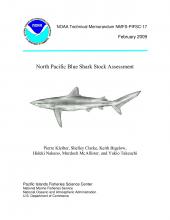
North Pacific blue shark stock assessment
Biodiversity Conservation
Available Online

Kleiber, Pierre ... [et al.]

2009
A stock assessment of the blue shark (Prionace glauca) population in the North Pacific was conducted using catch and effort data from commercial longline and large mesh driftnet fisheries from the years 1971 through 2002 as well as small mesh driftnet fisheries operating primarily in the 1980s. Because reporting of shark catch has not been required in these fisheries, which target primarily tunas, a system for identifying the more reliable longline catch reports was utilized. Two different assessment models were utilized, a surplus production model, and an integrated age and spatial structured model tested with a variety of structural assumptions. The two models were found to be in general agreement. The trends in abundance in the production model and all alternate runs of the integrated model show the same pattern of decline in the 1980s followed by recovery to above the level at the start of the time series. The integrated model analyses indicated some probability (around 30%) that biomass at the end of the time series was less than BMSY (overfished) and that there was a lesser probability at that time that fishing mortality was greater than FMSY (overfishing occurring). There was an increasing trend in total effort expended by longline fisheries toward the end of the time series, and this trend may have continued thereafter. It would be prudent to assume that the population is at least close to MSY level and fishing mortality may be approaching to the MSY level in the future.
The right to survive: the humanitarian challenge for the twenty-first century
Climate Change Resilience

Schuermer-Cross, Tanja

,

Taylor, Ben Heaven

2009
Each year, on average, almost 250 million people are affected by ‘natural’ disasters. In a typical year between 1998 and 2007, 98 per cent of them suffered from climate-related disasters such as droughts and floods rather than, for example, devastating but relatively rare events such as earthquakes. According to new research for this report, by 2015 this could grow by more than 50 per cent to an average of over 375 million affected by climate-related disasters each year. Any such projection is not an exact science, but it is clear that substantially more people may be affected by disasters in the very near, not just distant, future, as climate change and environmental mismanagement create a proliferation of droughts, landslides, floods and other local disasters. And more people will be vulnerable to them because of their poverty and location. Some of these environmental changes will also increase the threat of new conflicts, which will mean more people displaced, and more need for humanitarian aid. One recent report estimated that 46 countries will face a ‘high risk of violent conflict’ when climate change exacerbates traditional security threats. Already, there is evidence that the number of conflicts is again on the rise,5 while the threat of long-running conflicts creating vast new humanitarian demands was painfully shown by the upsurge of violence in the eastern Democratic Republic of Congo in 2008. In short, by 2015, an unprecedented level of need for humanitarian assistance could overwhelm the world’s current humanitarian capacity. Already, many governments fail to cope with threats like storms, floods and earthquakes. They fail to act quickly or effectively enough in response to these events, or to take preventative action to reduce unnecessary deaths and suffering. Indeed, the very actions of some governments and their national elites place marginalised people at risk from disasters by discriminating against them, like those forced to live in flimsy slum housing so easily destroyed by floods and landslips. At the same time, international humanitarian assistance is often too slow or inappropriate, and the UN-led reforms since 2005 to improve it have only begun to make a difference.
Evaluating the role of science in community based adaptive management of coastal resources in Fiji
Available Online

Seidel Henrike

2009
Community-based adaptive management (CBAM) has generally been accepted as an effective means to sustainably manage coastal ecosystems and small scale fishing activities. This particularly applies to areas where indigenous communities have significant control over their resources through customary marine tenure (CMT) such as the South Pacific. In Fiji CBAM is employed as a national strategy for coastal area management with over 300 communities involved. Activities are coordinated by the Fiji Locally-Managed Marine Area (FLMMA) Network which aims to integrate modern scientific knowledge with traditional management and governance systems for improved coastal area management. The use and degree of natural science required to support CBAM, however, is not well defined and viewpoints vary greatly between stakeholders and managers. This thesis highlights the actual and the potential use of natural science to be integrated into CBAM and support sustainable management at various levels of governance. Particularly, existing approaches such as participatory community-based biological monitoring are discussed. Statistical analysis of generated data was used to review the quality of this key scientific input to CBAM. Interviews were conducted with managers, scientists, government personnel, and community members to determine different stakeholder priorities and information needs for the CBAM approach. This allowed to examine how current efforts are addressing these priorities and needs at various governance levels and where potential use for future science interventions lie. Existing biophysical data from Fiji were compiled to propose suitable methods for predictive coordinative planning such as modelling approaches. In addition, alternative monitoring and evaluation methods are discussed. The study suggests that the supporting function of natural science to CBAM has not been fully exploited to date. Current procedures to generate site based scientific knowledge tend to be limited in their scope, and appear to be having limited direct impact on management of coastal resources. The main issues that prevent effective use of existing scientific knowledge are a lack of clearly defined objectives, a lack of capacity, deficient communication of scientific outputs, and a need for increased community education and training. These limitations combined with the degree and capacity to which communities can effectively benefit from the collection and interpretation of data based on scientific methodologies without continuous external input, need to be revised. At mid and national level and for improved project facilitation, there is potential to use novel approaches. This however, will require the amelioration of capacity and support functions.