Search the SPREP Catalogue

Refine Search Results

Tags / Keywords

Available Online

Tags / Keywords

Available Online

1088 result(s) found.

Sort by

You searched for

  • Collection BRB
    X
Conservation of the Tahiti flycatcher (Pomarea nigra) : Report on advice provided to Societe d'Ornithologie de Polynesie
Biodiversity Conservation, BRB
Available Online

Blanvillian, C.

,

Pierce, R.J.

2000
The Tahiti flycatcher (Pomarea nigra) is one of several monarch flycatcher species in the Polynesian genus Pomarea, all of which are threatened. The Tahiti flycatcher is currently known from only the western side of Tahiti where, during the 1998-99 season, at least 24 individuals, including 10 pairs, were located in four valleys (Blanvillain 1999). Although ten nests were protected from rats in 1998-99, only three were successful in fledging young. Two of these young apparently disappeared one week after fledging and the third, two months after fledging (Blanvillain 1999). Concern was raised about the possible predation by common myna (Acridotheres tristis), and/or red-vented bulbul (Pycnonotus cafer) on juveniles. In 1999-2000 the Societe d'Ornithologie de Polynesie (MANU) was granted funding for Tahiti flycatcher conservation by the South Pacific Regional Environment Programme (SPREP). During 13-26 September 1999, RP visited Tahiti to advise and help CB with aspects of the programme. This advisory work was funded by the N.Z. Ornithological Congress Trust Board (ICBP). It builds on work by Gaze & Blanvillain (1998) funded by the Pacific Development and Conservation Trust.
Rodent baits and delivery systems for island protection / Cheryl E. O'Connor and Charles T. Eason
BRB
Available Online

Eason, Charles T.

,

O'Connor, Cheryl E.

2000
There are five toxicants (brodifacoum, bromadialone, coumatetralyl, diphacinone, and flocoumafen) registered for rodent control in New Zealand. They are all anticoagulants and are available in water-resistant bait formulations (i.e. wax coating, wax block, or egg). Several new rodenticide products, which are currently in the process of being developed or registered, including a new anticoagulant difethialone, have also been identified. There are no published data on the relative effectiveness, palatability, or durability of the existing rodenticides for field use under New Zealand conditions. However, relevant published information on laboratory and wild rodents is reviewed. It is concluded that the highest priority should be to assess the four weather resistant, second-generation anticoagulant products (Pestoff® Rodent block, Talon® 50WB, Contrac®, and Baraki®) for palatability, durability, and effectiveness for an island protection situation. Improvements could then be made to the existing products if required with additives to improve palatability or durability, lures to attract rodents, and repellents for non-target insect, lizard and bird species. Trials of an alternative (e.g. cholecalciferol) to the persistent anticoagulants should also be considered for island protection. The most rodent-attractive bait station which also eliminates bird access needs to be determined for the complete island protection system.
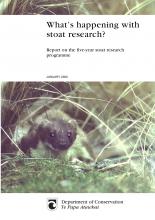
What's happening with stoat research? Report on the five-year stoat research programme
BRB
Available Online
2000
In the May 1999 budget, the New Zealand Government announced that an extra $6.6 million over five years would be given to the Department of Conservation to fund an integrated stoat control research programme. Stoats, ferrets and weasels were introduced to New Zealand in the 1880s in an attempt to control rabbits. Although stoats were implicated in the decline of some native bird species soon after their introduction, the extent to which they are still contributing to the decline of native species is only now becoming clear. Their impacts on threatened and endangered birds are of particular concern. Stoat control in New Zealand will have to be ongoing if some endemic species are to survive on the mainland. Currently, stoat control relies largely on labour-intensive trapping and the use of poisoned hen eggs. New, more cost-effective and sustainable approaches to controlling stoats are urgently needed. The extra funding means that there is now a real opportunity for finding cost-effective solutions for managing stoats. A Stoat Technical Advisory Group (composed of experts from the Department of Conservation, Lincoln University and Auckland University) has been established to develop and oversee this new research programme. Funding for the first year is $338,000 with funding increasing in 2000/01 to $1.406 million and for the subsequent three years, $1.631 million, each year.