Search the SPREP Catalogue

Refine Search Results

Tags / Keywords

Tags / Keywords

9005 result(s) found.

Sort by

You searched for

  • Available Online Yes
    X
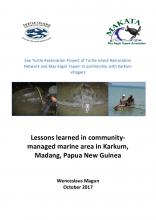
Sea Turtle Restoration Project of Turtle Island Restoration Network and Mas Kagin Tapani in partnership with Karkum villagers - Lessons learned in community-managed marine area in Karkum, Madang, Papua New Guinea
Available Online

Magun, Wenceslaus

2017
This paper was informed by literature review, review of project activities and interviews with key leaders from Karkum, and other local communities the Sea Turtle Restoration Project (STRP) team has worked with in Madang, Papua New Guinea. Local communities and other stakeholders were informed about the critical status of the Pacific leatherback sea turtle (Dermochelys coriacea) which is being pushed to the verge of extinction. The paper further showed the seven resource management planning steps used that enabled Karkums to establish their Community-managed Marine Area using Conservation Deed (CMMA-CD) on 17th November 2008. The Karkum STRP experience points out that some of the root causes of environmental destruction, often begins with lack of community control over resources and the inequitable distribution of money and power. These conflicts are further inflamed by misconceived “cargo cult” demands. To overcome some of these challenges, the paper indicated that Mas Kagin Tapani (MAKATA) needs long-term funding to carry out further turtle awareness, and conduct problem tree analysis workshop(s) to review the Karkum-Mirap conservation Map, and the Karkum CMMA-CD. Funds will also be used to carry out sea turtles tagging and beach monitoring exercises, conduct a training needs analysis study, and meet the recommendations identified in the training needs analysis study. If funded MAKATA will continue to develop and distribute educational awareness materials to local communities and other stakeholders. The paper revealed further that additional funds are needed by MAKATA to build its infrastructure, recruit staff, and meet its management and governance issues.
The Best of Both Worlds: A decision-making framework for combining traditional and contemporary forecast systems
Climate Change Resilience
Available Online

Chambers, Lynda D.

,

Finn, Charlotte K.

,

Plotz, Roan D.

2017
In most countries, national meteorological services either generate or have access to seasonal climate forecasts.However,inanumberofregions,theuptakeoftheseforecastsbylocalcommunitiescanbelimited, with the locals instead relying on traditional knowledgeto make their climate forecasts.Both approachesto seasonal climate forecasting have bene ts, and the incorporation of traditional forecast methods into contemporaryforecastsystemscanleadtoforecaststhatarelocallyrelevantandbettertrustedbytheusers.This in turn could signi cantly improve the communication and application of climate information, especially to remote communities. A number of different methodologies have been proposed for combining these forecasts. Through considering the bene ts and limitations of each approach, practical recommendations are providedonselectingamethod,intheformofadecisionframework,thattakesintoconsiderationbothuser and provider needs. The framework comprises four main decision points: 1) consideration of the level of involvement of traditional-knowledge experts or the community that is required, 2) existing levels of traditional knowledge of climate forecasting and its level of cultural sensitivity, 3) the availability of long-term data—both traditional-knowledge and contemporary-forecast components, and 4) the level of resourcing available.Noonemethodissuitableforeveryoneandeverysituation;however,thedecisionframeworkhelps to select the most appropriate method for a given situation.
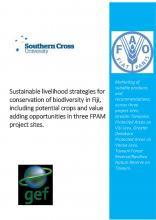
Sustainable livelihood strategies for conservation of biodiversity in Fiji, including potential crops and value adding opportunities in three FPAM project sites - Marketing of suitable products and recommendations; across three project sites: Greater Tomaniivi Protected Areas on Viti Levu, Greater Delaikoro Protected Areas on Vanua Levu, Taveuni Forest Reserve/Ravilevu Nature Reserve on Taveuni.
Biodiversity Conservation
Available Online

Addinsall, Cherise (Dr.)

,

FAO

,

Glencross, Kevin (Dr.)

,

Hancock, Wayne (Dr.)

,

Kete, Tevita

,

Prasad, Vinesh

2017
Conservation of biodiversity, improving rural livelihoods and supporting sustainable agriculture are key issues globally, but for many Pacific Island Countries (PICs) key biodiversity reserves are under considerable pressure from clearing and degradation. Rural communities are often put in a situation where clearing of forest margins is undertaken to meet demand for arable land to produce food and generate income. Forest reserves are also degraded by logging, where timber royalties are important in the absence of other sources of income for traditional landowners and communities. Therefore, agroforestry and ecologically based agriculture systems in the forest margins can help to offset reliance on forest degradation and can enhance the buffers around key reserves. Sustainable forest management and ecotourism also need to be maximised to help meet these challenges of generating income whilst maintaining or enhancing biodiversity, conserving soil and water resources.