Search the SPREP Catalogue

Refine Search Results

Language

Available Online

Available Online

48 result(s) found.

Sort by

You searched for

  • Available Online Yes
    X
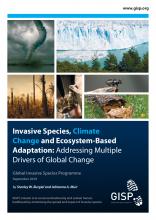
Invasive species, climate change and ecosystem-based adaptation: addressing multiple drivers of global change
Climate Change Resilience, BRB
Available Online

Burglele Stanley W.

,

Muir Adrianna A

2010
This report is targeted at policy-makers, particularly those responsible for developing climate mitigation and adaption strategies that address issues like conservation, ecosystem services, agriculture and sustainable livelihoods. It focuses on the primary linkages between invasive species and climate change, as well as the secondary and tertiary interactions of their corresponding impacts. Finally, the enclosed recommendations are intended to provide guidance on the best ways to integrate invasive species prevention and management into the consideration of climate change responses across a range of sectors. Building on a review of existing scientific and conservation literature (which is frequently centered on well-studied invasive species in developed countries), our research has reaffirmed that there are significant gaps and questions about the intersection of these two major drivers of change. The case studies included below highlight key relationships and questions related to invasive species, climate change and the role of ecosystem-based adaptation. The three key messages that can be distilled from this report are: 1. Climate change will have direct and second order impacts that facilitate the introduction, establishment and/or spread of invasive species. 2.Invasive species can increase the vulnerability of ecosystems to other climate-related stressors and also reduce their potential to sequester greenhouse gasses. 3.Using an ecosystem-based adaptation approach, these pressures on ecosystems and their ability to provide important services can be offset by preventing the introduction of new invasive species and by eradicating or controlling those damaging species already present.
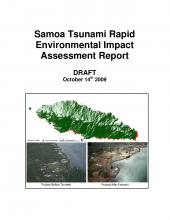
Samoa Tsunami rapid environmental impact assessment report: draft October 14th 2009
Biodiversity Conservation
Available Online

Ifopo, Pulea Etiseli

2009
A rapid assessment of the environmental impacts of the 29 September tsunami was conducted by a multi-agency team from 3 to 14 October, 2009. Fourteen “green” and 10 “brown” environmental variables were selected and measured based on the experience of the survey team and similar reports from elsewhere. During a tour of the affected area on Upolu by car and on foot those “assessable” variables were scored “high” (over two thirds affected), “medium” (over one third, less than two thirds affected), “low” (less than a third affected) or zero (unaffected). Manono and Savaii were surveyed by air with the former showing evidence of some damage and the later apparently none or very little. The most affected areas in Upolu were villages in the Aleipata, Lepa and Falealili districts with the most obvious indicators of the tsunami’s impact being solid waste (sometimes resulting from the complete destruction of a village), erosion of the beach and fore-shore and the (expected) impact on marine resources. Other environmental variables assessed also showed similar patterns. Impacts on a wharf/dry dock facility are also described (including lost fuel drums) as are the possible environmental implications of new settlements created by displaced persons (mainly revolving around sanitation, drainage and water supply).
Status of the coral reefs in the South west Pacific: Fiji, New Caledonia, Samoa, Solomon Islands, Tuvalu and Vanuatu
Biodiversity Conservation
Available Online

Mackay Kenneth

,

Morris Cherie

2008
Fiji, New Caledonia, Vanuatu, Solomon Islands, Samoa and Tuvalu report monitoring data for this report, with data from a broad range of observers (scientists, students, dive guides and communities); Nauru has not conducted recent monitoring; Coral cover has changed since the 2004 report due to effective management (positive), or local disturbances, coral predation and natural disasters (negative). Average coral cover at monitoring sites was 45% in Fiji; 27% in New Caledonia; 43% in Samoa; 30% in Solomon Islands; 65% in Tuvalu; and 26% in Vanuatu; Monitoring observations over 9-10 years in Fiji and New Caledonia indicate that these reefs have coped reasonably well with natural and human stressors without catastrophic changes; Densities of edible fish and invertebrates remained generally low (0-10/100m2) in 4 countries reflecting high subsistence and commercial fishing pressure. Butterflyfish, parrotfish, surgeonfish and damselfish were generally most dominant. High densities of parrotfish were reported from 4 countries; Socioeconomic monitoring is conducted in Fiji, Samoa and Solomon Islands. Greatest activity is by the Fiji Locally Marine Managed Area (FLMMA) network at 270 villages across all Fiji provinces. Most households harvest marine resources for subsistence and partially for sale, with few commercial fishers. In Samoa, more people eat canned fish than fresh fish, possibly because of decreased fish stocks in the last 10 years. In the Solomon Islands, some traditional managed systems have collapsed due to poor understanding of fisheries and resource management issues or poor national regulations. Mangrove destruction and greater fishing pressure are reducing family incomes;