Search the SPREP Catalogue

Refine Search Results

Publication Year

Available Online

Publication Year

Available Online

6 result(s) found.

Sort by

You searched for

Dispositif de suivi de l'abondance et de l'impact du cerf - Fiche finale de capitalisation - PROTEGE
SPREP Publications, Biodiversity Conservation, BRB
Available Online

PROE / SPREP

2025
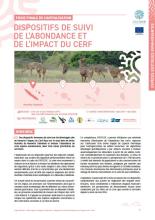
Des dispositifs innovants de suivi ont été développés afin de mesurer l’impact du Cerf Rusa sur le sous-bois de forêts humides de Nouvelle Calédonie et évaluer l’abondance de cette espèce envahissante, dans trois zones prioritaires du territoire. L’élaboration de ces dispositifs poursuit des objectifs complémentaires aux actions de régulation professionnelle mises en œuvre dans le cadre de PROTEGE. Le suivi vise notamment à réaliser un état initial et à évaluer les bénéfices des opérations de régulation, grâce à des outils adaptés à des zones d’intervention difficiles d’accès et caractérisées par une biodiversité exceptionnelle, plus de 80% des espèces végétales des forêts humides d’altitude étant endémiques à la Nouvelle-Calédonie. Un travail initial de sectorisation a permis mieux de caractériser les enjeux, les pressions sur l’environnement ainsi que le contexte socio-économique afin de délimiter les zones d’intervention prioritaires. Pour la première fois en Nouvelle-Calédonie, un protocole standardisé de mesure de l’impact des cerfs a été élaboré. Il s’appuie sur plusieurs indicateurs et prend en compte les spécificités des espèces végétales concernées et des contraintes associées à sa mise en œuvre. En complément, PROTEGE a permis d’élaborer une méthodeinnovante d’évaluation de l’abondance des cerfs, reposant sur l’utilisation d’un drone équipé de capteur thermique pour l’enregistrement de vidéos nocturnes. Un algorithme développé spécifiquement a par ailleurs vocation à réaliser automatiquement les détections à partir de ces vidéos, facilitant considérablement le traitement des données. La mise en œuvre de ce protocole pour la prospection de 4 700 hectares a révélé des densités de populations et des concentrations de hardes localement très élevées, atteignant par endroits des niveaux parmi les plus élevés enregistrés à l’échelle mondiale. Ces résultats fournissent des informations précieuses pour le ciblage de futures interventions et le suivi de leurs bénéfices. FICHE FINALE DE CAPITALISATION DU PROJET PROTEGE, financé par l'Union Européenne.
Scaling down (cliffs) to meet the challenge: the Shiants’ black rat eradication
Biodiversity Conservation, BRB
Available Online

Bambini, L.

,

Bell, E.

,

Campbell, G.

,

Churchyard, T.

,

Douse, A.

,

Floyd, K.

,

Ibbotson, J.

,

Main, C.E.

,

Nicolson, T.

,

Reid, R.

,

Taylor, P.R.

,

Tayton, J.

,

Varnham, K.

,

Whittington, W.

2019
A successful ground-based eradication of black rats (Rattus rattus) was undertaken on the remote, uninhabited Shiant Isles of north-west Scotland over winter (14 October–28 March) 2015–16. The rat eradication was carried out as part of the Shiants Seabird Recovery Project, which aims to secure long-term breeding habitat for protected seabirds and to attract European storm petrels and Manx shearwaters to nest on the Shiants. Throughout the eradication operation, teams were stationed on two of the three main Shiant islands (Eilean an Tighe, Eilean Mhuire), with access to the third (Garbh Eilean) via a boulder causeway from Eilean an Tighe. Bait (Contrac® blocks containing the anticoagulant bromadiolone 0.005% w/w), was deployed in a grid of 1,183 bait stations covering all areas of the islands and sea stacks. Bait stations were set 50 m apart, with intervals reduced to 25 m in coastal areas of predicted high rat density. Difficult areas were accessed by boat and cliff s of ~120 m in height were accessed by abseiling down ropes made safe using either bolted anchors or ground stakes. The team of staff and volunteers worked through difficult conditions, deploying bait and monitoring intensively for any surviving rats using a combination of tools. The islands were declared rat free in March 2018. This ambitious and challenging project has greatly enhanced UK capacity in rodent eradications for the purposes of conservation.
The Isles of Scilly seabird restoration project: the eradication of brown rats (Rattus norvegicus) from the inhabited islands of St Agnes and Gugh, Isles of Scilly
Biodiversity Conservation, BRB
Available Online

Bell, E.

,

Boyle, D.

,

Buckley, P.

,

Floyd, K.

,

Garratt, W.

,

Lock, L.

,

Mason, S.

,

McCarthy, R.

,

Pearce, J.

,

Pearson, J.

,

St Pierre, P.

,

Sugar, K.

2019
As part of the Isles of Scilly Seabird Recovery Project, and directed by Wildlife Management International Ltd, the eradication of brown rats (Rattus norvegicus) from the inhabited islands of St Agnes & Gugh, Isles of Scilly was completed between October 2013 and April 2014 with the assistance of volunteers, and staff from the Royal Society for the Protection of Birds, Isles of Scilly Wildlife Trust and Natural England. Bait stations with cereal-based wax blocks containing bromadiolone at 0.005% w/w were established on a 40–50 metre grid over the island. With the presence of 85 residents on the 142 ha islands, this is the largest community-based brown rat eradication globally to date. Given the fact that a community is based on these islands, community engagement and advocacy was a vital and fundamental part of the eradication. Consultation for eradication began three years prior to the operation to explain the requirements for the proposed project and to assess support, but this built on many years of wider community engagement with seabird conservation. All of the residents supported the eradication of rats and vision of the project. The consultation and inclusion of the community in decision-making and management of the Isles of Scilly Seabird Recovery Project was a critical part of the operation and key to the success of the eradication. The community took ownership of the project and has committed to the on-going biosecurity requirements following the eradication of rats. The removal of brown rats from St Agnes and Gugh was a major achievement and provided the opportunity to restore the islands' communities of seabirds and other native species. This project provided an example of the effectiveness of ground-based rodent eradication techniques on an inhabited island and the lessons learnt during this operation can be used to help proposed eradications on other islands with communities and with terrain suitable for ground-based techniques.
Persistence, accuracy and timeliness: finding, mapping and managing non-native plant species on the island of South Georgia (South Atlantic)
Biodiversity Conservation, BRB
Available Online

Floyd, K.

,

Lee, J.

,

Myer, B.

,

Pass?eld, K.

,

Poncet, S.

2019
The South Georgia ecosystem-based habitat restoration project is a major project that began with the eradication of invasive rats (Rattus norvegicus) and reindeer (Rangifer tarandus), 2011–2017. As part of this restoration programme a non-native plant management strategy was developed and implemented. With only 8% of the whole South Georgia landmass suitable for vascular plants (ca. 283 km²) due to permanent ice and bare rock, there have been 25 indigenous vascular plants and 41 non-native plants recorded from earlier surveys. Following removal of grazing pressure from introduced mammals, surveys were conducted to quantify the current status and distribution of non-native plant populations and enable a non-native plant control strategy to be developed for the island. Due to the vast scale of the island, multiple seasons were required to carry out rapid surveys of key indicators such as species, area of plant coverage in square metres and age class (mature or juvenile). Survey and control data were entered into a spatial database to enable analysis, allow data-informed management decisions and be used for long-term control-based monitoring of outcomes. During this series of surveys, 44 naturalised, non-native plant species were identi?ed and mapped. Of these, 34 species are now being managed at zero density with 56,851 m2 at 184 sites controlled to date; four are managed at speci?c sites with 22,443 m2 controlled to date, three require con?rmation of species and the remaining three species are widely established and receive limited control. Spatially quantifying the distribution and control of non-native plants has enabled the development and implementation of an e?ective management strategy which contributes to the restoration of South Georgia’s native biodiversity.