Search the SPREP Catalogue

Refine Search Results

Tags / Keywords

Available Online

Tags / Keywords

Available Online

128 result(s) found.

Sort by

You searched for

Archipelago-wide island restoration in the Galapagos Islands: Reducing costs of invaisve mammal eradication programs and reinvasion risk
BRB
Available Online

Campbell, Karl J.

,

Carrion, Victor

,

Cruz, Felipe

,

Donian, C. Josh

,

Lavoie, Christian

2011
Invasive alien mammals are the major driver of biodiversity loss and ecosystem degradation on islands. Over the past three decades, invasive mammal eradication from islands has become one of society's most powerful tools for preventing extinction of insular endemics and restoring insular ecosystems. As practitioners tackle larger islands for restoration, three factors will heavily influence success and outcomes: the degree of local support, the ability to mitigate for non-target impacts, and the ability to eradicate non-native species more cost-effectively. Investments in removing invasive species, however, must be weighed against the risk of reintroduction. One way to reduce reintroduction risks is to eradicate the target invasive species from an entire archipelago, and thus eliminate readily available sources. We illustrate the costs and benefits of this approach with the efforts to remove invasive goats from the Galápagos Islands. Project Isabela, the world's largest island restoration effort to date, removed > 140,000 goats from > 500,000 ha for a cost of US$10.5 million. Leveraging the capacity built during Project Isabela, and given that goat reintroductions have been common over the past decade, we implemented an archipelago-wide goat eradication strategy. Feral goats remain on three islands in the archipelago, and removal efforts are underway. Efforts on the Galápagos Islands demonstrate that for some species, island size is no longer the limiting factor with respect to eradication. Rather, bureaucratic processes, financing, political will, and stakeholder approval appear to be the new challenges. Eradication efforts have delivered a suite of biodiversity benefits that are in the process of revealing themselves. The costs of rectifying intentional reintroductions are high in terms of financial and human resources. Reducing the archipelago-wide goat density to low levels is a technical approach to reducing reintroduction risk in the short-term, and is being complemented with a longer-term social approach focused on education and governance.
Encyclopedia of biological invasions.
Biodiversity Conservation, BRB

Rejmanek, Marcel

,

Simberloff, Dadniel

2011
This encyclopedia illuminates a topic at the forefront of global ecology - biological invasions, or organisms that come to live in the wrong place. Written by leading scientists from around the world, the book addresses all aspects of this subject at a global level - including invasions by animals, plants, fungi, and bacteria - in succinct, alphabetically arranged articles. Scientifically uncompromising, yet clearly written and free of jargon, the volume encompasses fields of study including biology, demography, geography, ecology, evolution, sociology, and natural history and features many cross-references, suggestions for further reading, illustrations, an appendix of the world's worst 100 invasive species, a glossary, and more. The book features articles on well-known invasive species such the zebra mussel, chestnut blight, cheatgrass, gypsy moth, Nile perch, giant African snail, and Norway rat and details regions with especially large numbers of introduced species including the Great Lakes, Mediterranean Sea, Hawaiian Islands, Australia and New Zealand. This work will be of great value in ecology and conservation science. Invasive species are a severe and exponentially growing problem of the environment, and one difficult even to characterize, much less contain.-Edward O. Wilson, author and scientist "Second only to habitat loss mixed with climate disruption, invasive species represent the next most serious threat to biodiversity. The Encyclopedia of Biological Invasions, written by an impressive group of experts, now makes available to conservation biologists, managers, decision makers, and concerned citizens a comprehensive single source of this key topic."-Paul R. Ehrlich, co-author of The Dominant Animal
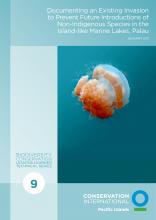
Documenting an existing invasion to prevent future introductions of non-indigenous species in the island-like marine lakes, Koror, Palau
Biodiversity Conservation, BRB
Available Online

Patris, Sharon ... [et al.]

2011
This document is part of a technical report series on conservation projects funded by the Critical Ecosystem Partnership Fund (CEPF) and the Conservation International Pacific Islands Program (CI-Pacific). The main purpose of this series is to disseminate project findings and successes to a broader audience of conservation professionals in the Pacific, along with interested members of the public and students. The reports are being prepared on an ad-hoc basis as projects are completed and written up. In most cases the reports are composed of two parts, the first part is a detailed technical report on the project which gives details on the methodology used, the results and any recommendations. The second part is a brief project completion report written for the donor and focused on conservation impacts and lessons learned. The CEPF fund in the Polynesia-Micronesia region was launched in September 2008 and will be active until 2013. It is being managed as a partnership between CI Pacific and CEPF. The purpose of the fund is to engage and build the capacity of non-governmental organizations to achieve terrestrial conservation. The total grant envelope is approximately US$6 million, and focuses on three main elements: the prevention, control and eradication of invasive species in key biodiversity areas (KBAs); strengthening the conservation status and management of a prioritized set of 60 KBAs and building the awareness and participation of local leaders and community members in the implementation of threatened species recovery plans.
Invasive species, climate change and ecosystem-based adaptation: addressing multiple drivers of global change
Climate Change Resilience, BRB
Available Online

Burglele Stanley W.

,

Muir Adrianna A

2010
This report is targeted at policy-makers, particularly those responsible for developing climate mitigation and adaption strategies that address issues like conservation, ecosystem services, agriculture and sustainable livelihoods. It focuses on the primary linkages between invasive species and climate change, as well as the secondary and tertiary interactions of their corresponding impacts. Finally, the enclosed recommendations are intended to provide guidance on the best ways to integrate invasive species prevention and management into the consideration of climate change responses across a range of sectors. Building on a review of existing scientific and conservation literature (which is frequently centered on well-studied invasive species in developed countries), our research has reaffirmed that there are significant gaps and questions about the intersection of these two major drivers of change. The case studies included below highlight key relationships and questions related to invasive species, climate change and the role of ecosystem-based adaptation. The three key messages that can be distilled from this report are: 1. Climate change will have direct and second order impacts that facilitate the introduction, establishment and/or spread of invasive species. 2.Invasive species can increase the vulnerability of ecosystems to other climate-related stressors and also reduce their potential to sequester greenhouse gasses. 3.Using an ecosystem-based adaptation approach, these pressures on ecosystems and their ability to provide important services can be offset by preventing the introduction of new invasive species and by eradicating or controlling those damaging species already present.
Climate change and water: technical paper of the IPCC
Climate Change Resilience, Biodiversity Conservation
Available Online

Bates, Bryson

,

Kundzewicz, Zbigniew

,

Palutikof Jean

,

Wu, Shaohon Wu

2008
Observational records and climate projections provide abundant evidence that freshwater resources are vulnerable and have the potential to be strongly impacted by climate change, with wide-ranging consequences for human societies and ecosystems. Observed warming over several decades has been linked to changes in the large-scale hydrological cycle such as: increasing atmospheric water vapour content; changing precipitation patterns, intensity and extremes; reduced snow cover and widespread melting of ice; and changes in soil moisture and runoff. Precipitation changes show substantial spatial and inter-decadal variability. Over the 20th century, precipitation has mostly increased over land in high northern latitudes, while decreases have dominated from 10°S to 30°N since the 1970s. The frequency of heavy precipitation events (or proportion of total rainfall from heavy falls) has increased over most areas (likely). Globally, the area of land classified as very dry has more than doubled since the 1970s (likely). There have been significant decreases in water storage in mountain glaciers and Northern Hemisphere snow cover. Shifts in the amplitude and timing of runoff in glacier- and snowmelt-fed rivers, and in ice-related phenomena in rivers and lakes, have been observed (high confidence).