Search the SPREP Catalogue

Refine Search Results

Related Countries

Language

Available Online

Related Countries

Available Online

91 result(s) found.

Sort by

You searched for

Nature-Based Solutions to Climate Change Adaptation in Urban Areas
Available Online

Nadja Kabisch, Horst Korn, Jutta Stadler, Aletta Bonn

2017
This book series Theory and Practice of Urban Sustainability Transitions is intended to explore the different dynamics, challenges, and breakthroughs in accelerating sustainability transitions in urban areas across the globe. We expect to find as much different and diverse stories, visions, experiments, and creative actors as there are cities: from metropolises to country towns, from inner city districts to suburbs, from developed to developing, from monocultural to diverse, and from hierarchical to egalitarian. But we also expect to find patterns in processes and dynamics of transitions across this diversity. Transition dynamics include locked-in regimes that are challenged by changing contexts, ecological stress and societal pressure for change as well as experiments and innovations in niches driven by entrepreneurial networks, and creative communities and proactive administrators. But also included are resistance by vested interests and sunken costs, uncertainties about the future amongst urban populations, political instabilities, and the erosion of social services and systems of provision. And finally there are the forming of transformative arenas, the development of coalitions for change across different actor groups, the diffusion and adoption of new practices, and exponential growth of sustainable technologies. For this series we seek this middle ground: between urban and transition perspectives, between conceptual and empirical, and between structural and practical. We aim to develop this series to offer scholars state-of-the-art theoretical developments applied to the context of cities. Equally important is that we offer urban planners, professionals, and practitioners interested or engaged in strategic interventions to accelerate and guide urban sustainability transition frameworks for understanding and dealing with on-going developments, methods, and instruments. This book series will lead to new insights into how cities address the sustainability challenges they face by not returning to old patterns but by searching for new and innovative methods and instruments that are based on shared principles of a transitions approach. Based on concrete experiences, state-of-the-art research, and ongoing practices, the series provides rich insights, concrete and inspiring cases as well as practical methods, tools, theories, and recommendations. The book series, informed by transition thinking as it was developed in the last decade in Europe, aims to describe, analyse, and support the quest of cities around the globe to accelerate and stimulate such a transition to sustainability. To sum up, the book series aims to: – Provide theory, case studies, and contextualized tools for the governance of urban transitions worldwide – Provide a necessary and timely reflection on current practices of how transition management is and can be applied in urban contexts worldwide – Further the theorizing and conceptual tools relating to an understanding of urban sustainability transitions – Provide best practices of cities across countries and different kinds of cities as well as across policy domains in shaping their city’s path towards sustainability
Understanding the Bigger Energy Picture
Available Online

Michael Düren

2017
Since thousands of years, the human race has been developing cultural skills and technological capabilities that support its struggle for survival and lead to dominance over all other species. Since about a century, the exponential growth of knowledge, technology, industry and population (see Fig. 1.1) has reached a scale where man modifies biosphere to an extent, that living conditions on the whole planet earth start to change significantly. Resources that had been abundant are becoming scarce within decades. We have arrived in the Anthropocene [1] where man has a significant impact on the basic living conditions of the biosphere of the whole planet. A continuation of this growth rate will unavoidably reach its natural limits where resources vanish; the biosphere will change more rapidly than the ability of organisms and ecosystems to accommodate, and contaminations will endanger living. When such a condition is reached, it is likely that our human civilization will collapse and human population will diminish rapidly. Historic examples demonstrated that drought, hunger, wars and epidemics were typical endpoints of drastic environmental changes and overpopulation. While historic examples mostly affected only individual towns, islands, countries or indigenous nations, the limits of growth this time affect the whole planet and there is no “new world” to which our civilization can migrate. Recent research has proven that the era of a new biological mass extinction has already started [2] and it can be assumed that finally also our species will be affected.
Encyclopedia of biological invasions.
Biodiversity Conservation, BRB

Rejmanek, Marcel

,

Simberloff, Dadniel

2011
This encyclopedia illuminates a topic at the forefront of global ecology - biological invasions, or organisms that come to live in the wrong place. Written by leading scientists from around the world, the book addresses all aspects of this subject at a global level - including invasions by animals, plants, fungi, and bacteria - in succinct, alphabetically arranged articles. Scientifically uncompromising, yet clearly written and free of jargon, the volume encompasses fields of study including biology, demography, geography, ecology, evolution, sociology, and natural history and features many cross-references, suggestions for further reading, illustrations, an appendix of the world's worst 100 invasive species, a glossary, and more. The book features articles on well-known invasive species such the zebra mussel, chestnut blight, cheatgrass, gypsy moth, Nile perch, giant African snail, and Norway rat and details regions with especially large numbers of introduced species including the Great Lakes, Mediterranean Sea, Hawaiian Islands, Australia and New Zealand. This work will be of great value in ecology and conservation science. Invasive species are a severe and exponentially growing problem of the environment, and one difficult even to characterize, much less contain.-Edward O. Wilson, author and scientist "Second only to habitat loss mixed with climate disruption, invasive species represent the next most serious threat to biodiversity. The Encyclopedia of Biological Invasions, written by an impressive group of experts, now makes available to conservation biologists, managers, decision makers, and concerned citizens a comprehensive single source of this key topic."-Paul R. Ehrlich, co-author of The Dominant Animal
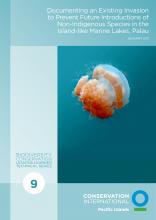
Documenting an existing invasion to prevent future introductions of non-indigenous species in the island-like marine lakes, Koror, Palau
Biodiversity Conservation, BRB
Available Online

Patris, Sharon ... [et al.]

2011
This document is part of a technical report series on conservation projects funded by the Critical Ecosystem Partnership Fund (CEPF) and the Conservation International Pacific Islands Program (CI-Pacific). The main purpose of this series is to disseminate project findings and successes to a broader audience of conservation professionals in the Pacific, along with interested members of the public and students. The reports are being prepared on an ad-hoc basis as projects are completed and written up. In most cases the reports are composed of two parts, the first part is a detailed technical report on the project which gives details on the methodology used, the results and any recommendations. The second part is a brief project completion report written for the donor and focused on conservation impacts and lessons learned. The CEPF fund in the Polynesia-Micronesia region was launched in September 2008 and will be active until 2013. It is being managed as a partnership between CI Pacific and CEPF. The purpose of the fund is to engage and build the capacity of non-governmental organizations to achieve terrestrial conservation. The total grant envelope is approximately US$6 million, and focuses on three main elements: the prevention, control and eradication of invasive species in key biodiversity areas (KBAs); strengthening the conservation status and management of a prioritized set of 60 KBAs and building the awareness and participation of local leaders and community members in the implementation of threatened species recovery plans.