Search the SPREP Catalogue

Refine Search Results

Language

Available Online

Available Online

51 result(s) found.

Sort by

You searched for

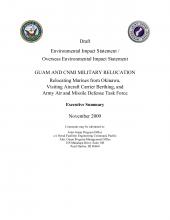
Overseas environmental impact statement: Guam and CNMI military relocation: relocating marines from Okinawa, visiting aircraft carrier berthing, and army air and missile defense task force: Executive summary : DRAFT
Biodiversity Conservation
Available Online

Naval Facilities Engineering Command, Pacific

2009
The National Environmental Policy Act of 1969 requires federal agencies to examine the environmental effects of their proposed actions. On behalf of the Department of Defense, the Department of the Navy is preparing this Draft EIS/OEIS to assess the potential environmental effects associated with the proposed military activities. The Navy is the lead agency for preparation of this Draft EIS/OEIS. The Office of the Secretary of Defense directed the Navy to establish a Joint Guam Program Office that serves as the NEPA proponent of the proposed actions. A number of federal agencies were invited to be cooperating agencies in the preparation of this Draft EIS/OEIS. These agencies have either jurisdiction or technical expertise for certain components of the proposed actions or a potentially affected resource. The agencies that have accepted the invitation to participate as cooperating agencies are United States (U.S.) Fish and Wildlife Service, Department of Transportation Federal Highways Administration, Federal Aviation Administration, U.S. Environmental Protection Agency Region 9, U.S. Office of Insular Affairs, U.S. Department of Agriculture, U.S. Army Corps of Engineers, and U.S. Air Force.
Climate change and water: technical paper of the IPCC
Climate Change Resilience, Biodiversity Conservation
Available Online

Bates, Bryson

,

Kundzewicz, Zbigniew

,

Palutikof Jean

,

Wu, Shaohon Wu

2008
Observational records and climate projections provide abundant evidence that freshwater resources are vulnerable and have the potential to be strongly impacted by climate change, with wide-ranging consequences for human societies and ecosystems. Observed warming over several decades has been linked to changes in the large-scale hydrological cycle such as: increasing atmospheric water vapour content; changing precipitation patterns, intensity and extremes; reduced snow cover and widespread melting of ice; and changes in soil moisture and runoff. Precipitation changes show substantial spatial and inter-decadal variability. Over the 20th century, precipitation has mostly increased over land in high northern latitudes, while decreases have dominated from 10°S to 30°N since the 1970s. The frequency of heavy precipitation events (or proportion of total rainfall from heavy falls) has increased over most areas (likely). Globally, the area of land classified as very dry has more than doubled since the 1970s (likely). There have been significant decreases in water storage in mountain glaciers and Northern Hemisphere snow cover. Shifts in the amplitude and timing of runoff in glacier- and snowmelt-fed rivers, and in ice-related phenomena in rivers and lakes, have been observed (high confidence).