Search the SPREP Catalogue

Refine Search Results

Available Online

Available Online

772 result(s) found.

Sort by

You searched for

  • Subject Fisheries
    X
  • Subject Environment - Protection
    X
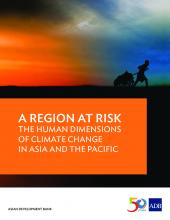
A region at risk - The human dimensions of climate change in Asia and the Pacific
Climate Change Resilience, Biodiversity Conservation
Available Online

Asian Development Bank

2017
The Asia and Pacific region is extremely vulnerable to the impacts of climate change. Unabated warming could significantly undo previous achievements of economic development and improvements of living standards. At the same time, the region has both the economic capacity and weight of influence to change the present fossil-fuel based development pathway and curb global emissions. This report sheds light on the regional implications of the latest projections of changes in climate conditions over Asia and the Pacific. The assessment concludes that, even under the Paris consensus scenario in which global warming is limited to 1.5°C to 2°C above preindustrial levels, some of the land area, ecosystems, and socioeconomic sectors will be significantly affected by climate change impacts, to which policy makers and the investment community need to adapt to. However, under a Business-As-Usual (BAU) scenario, which will cause a global mean temperature rise of over 4°C by the end of this century, the possibilities for adaptation are drastically reduced. Among others, climate change impacts such as the deterioration of the Asian “water towers”, prolonged heat waves, coastal sea-level rise and changes in rainfall patterns could disrupt ecosystem services and lead to severe effects on livelihoods which in turn would affect human health, migration dynamics and the potential for conflicts. This assessment also underlines that, for many areas vital to the region’s economy, research on the effects of climate change is still lacking.
Global Atlas of Marine Fisheries: A critical appraisal of catches and ecosystem impacts
Biodiversity Conservation

Pauly, Daniel (ed.)

,

Zeller, Dirk (ed.)

2016
Until now, there has been only one source of data on global fishery catches: information reported to the Food and Agriculture Organization of the United Nations by member countries. An extensive, ten-year study conducted by The Sea Around Us Project of the University of British Columbia shows that this catch data is fundamentally misleading. Many countries underreport the amount of fish caught (some by as much as 500%), while others such as China significantly overreport their catches. The Global Atlas of Marine Fisheries is the first and only book to provide accurate, country-by-country fishery data. This groundbreaking information has been gathered from independent sources by the world’s foremost fisheries experts, and edited by Daniel Pauly and Dirk Zeller of the Sea Around Us Project. The Atlas includes one-page reports on 273 countries and their territories, plus fourteen topical global chapters. National reports describe the state of the country's fishery, by sector; the policies, politics, and social factors affecting it; and potential solutions. The global chapters address cross-cutting issues, from the economics of fisheries to the impacts of mariculture. Extensive maps and graphics offer attractive and accessible visual representations. While it has long been clear that the world’s oceans are in trouble, the lack of reliable data on fishery catches has obscured the scale, and nuances, of the crisis. The atlas shows that, globally, catches have declined rapidly since the 1980s, signaling an even more critical situation than previously understood. The Global Atlas of Marine Fisheries provides a comprehensive picture of our current predicament and steps that can be taken to ease it. For researchers, students, fishery managers, professionals in the fishing industry, and all others concerned with the status of the world’s fisheries, the Atlas will be an indispensable resource.
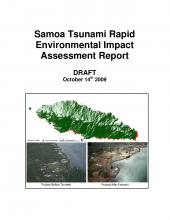
Samoa Tsunami rapid environmental impact assessment report: draft October 14th 2009
Biodiversity Conservation
Available Online

Ifopo, Pulea Etiseli

2009
A rapid assessment of the environmental impacts of the 29 September tsunami was conducted by a multi-agency team from 3 to 14 October, 2009. Fourteen “green” and 10 “brown” environmental variables were selected and measured based on the experience of the survey team and similar reports from elsewhere. During a tour of the affected area on Upolu by car and on foot those “assessable” variables were scored “high” (over two thirds affected), “medium” (over one third, less than two thirds affected), “low” (less than a third affected) or zero (unaffected). Manono and Savaii were surveyed by air with the former showing evidence of some damage and the later apparently none or very little. The most affected areas in Upolu were villages in the Aleipata, Lepa and Falealili districts with the most obvious indicators of the tsunami’s impact being solid waste (sometimes resulting from the complete destruction of a village), erosion of the beach and fore-shore and the (expected) impact on marine resources. Other environmental variables assessed also showed similar patterns. Impacts on a wharf/dry dock facility are also described (including lost fuel drums) as are the possible environmental implications of new settlements created by displaced persons (mainly revolving around sanitation, drainage and water supply).