Search the SPREP Catalogue

Refine Search Results

Tags / Keywords

Available Online

Tags / Keywords

Available Online

323 result(s) found.

Sort by

You searched for

  • Publication Year 2016
    X
Time-resolved record of 236U and 239,240Pu isotopes from a coral growing during the nuclear testing program at Enewetak Atoll (Marshall Islands)

Chan, W. Y.

,

Fallon, S. J.

,

Fifield, L. K.

,

Froehlich, M. B.

,

Tims, S. G.

2016
A comprehensive series of nuclear tests were carried out by the United States at Enewetak Atoll in the Marshall Islands, especially between 1952 and 1958. A Porites Lutea coral that was growing in the Enewetak lagoon within a few km of all of the high-yield tests contains a continuous record of isotopes, which are of interest (e.g. 14 C, 236 U, 239, 240 Pu) through the testing period. Prior to the present work, 14C measurements at ~2-month resolution had shown pronounced peaks in the D 14C data that coincided with the times at which tests were conducted. Here were port measurements of 236 U and 239, 240 Pu on the same coral using accelerator mass spectrometry, and again nd prominent peaks in the concentrations of these isotopes that closely follow those in 14C. Consistent with the 14C data, the magnitudes of these peaks do not, however, correlate well with the explosive yields of the corresponding tests, indicating that smaller tests probably contributed disproportionately to the debris that fell in the lagoon. Additional information about the different tests can also be obtained from the 236 U/ 239 Pu and 240 Pu/ 239 Pu ratios, which are found to vary dramatically over the testing period. In particular, the rst thermonuclear test, Ivy-Mike, has characteristic 236 U/239 Pu and 240 Pu/ 239 Pu signatures which are diagnostic of the rst arrival of nuclear test material in various archives.
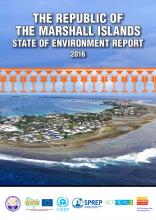
The Republic of the Marshall Islands: State of the Environment (SOE) Report 2016
Available Online
2016
The 2016 State of Environment (SOE) Report for the Republic of Marshall Islands (RMI) updates the 1992 SOE report. It uses the DPSIR model (Drivers, Pressures, State, Impact and Response) and aims to:| Document the key drivers and pressures behind the changing environment.| Assess the RMI environment since 1992, using the best available information on the state of RMI’s environment in seven key themes: Atmosphere and Climate, Land, Marine, Biodiversity, Culture and Heritage, Built Environment and Nuclear Legacy.| Document the impacts of environmental changes on the society, economy and environment from changes in the state of the environment.| Document current responses to protect and better manage RMI’s natural resources.| Provide recommendations for RMI to address key challenges and link them to actions in the National Environmental Management Strategy (NEMS) and other key policy documents. This report is comprised of three discussions: 1. Drivers and Pressures in Marshall Islands: A summary of the main points discussed in the Pressures and Drivers section of the report. 2.The State of RMI’s Environment and Impacts on the Society, Economy and Environment: Key findings for each of the seven themes. 3. Responses and Recommendations – Challenges in Moving from Policy to Action: This presents key responses, opportunities, challenges and recommendations.