Search the SPREP Catalogue

Refine Search Results

Language

Available Online

Available Online

9 result(s) found.

Sort by

You searched for

  • Collection Biodiversity Conservation
    X
Mainstreaming Ecosystem Services and Biodiversity into Agricultural Production and Management in the Pacific Islands - Technical guidance document
Biodiversity Conservation
Available Online

FAO

2016
The international community is increasingly aware of the link between biodiversity and sustainable development and its direct impact on wealth, health and well-being. Biodiversity is the origin of all crops and domesticated livestock. It is also the source of vital ecosystem services and functions, including soil conservation, water cycling, pollination, pest and disease regulation, carbon sequestration and nitrogen fixation. Biodiversity and the ecosystem services it supports are thus key to nutritional diversity and to agricultural productivity and resilience. The Convention on Biological Diversity (CBD) Strategic Plan for Biodiversity 2011–2020 and its 20 Aichi Biodiversity Targets provide a framework for countries to develop national targets and policies for sustaining biodiversity for a healthy planet. To meet rising global food demands, agricultural systems need to produce greater quantities of more diverse and nutritious food in a sustainable way. This progress can and must be achieved without driving biodiversity loss. It must come through gains in the efficiency of resource use, through sustainable intensification and a landscape perspective in agricultural production. By contributing to the conservation and sustainable use of biodiversity, agriculture will be a key driver for eliminating poverty, improving human health and providing energy, food and clean water for all while maintaining natural ecosystems.
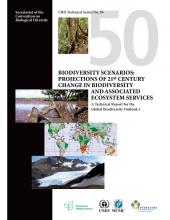
Biodiversity scenarios: projections of 21st century change in Biodiversity and associated Ecosystem Services: a technical report for the Global Biodiversity Outlook 3
Biodiversity Conservation
Available Online

Leadley, Paul ... [et al.]

2010
This synthesis focuses on estimates of biodiversity change as projected for the 21st century by models or extrapolations based on experiments and observed trends. The term “biodiversity” is used in a broad sense as it is defined in the Convention on Biological Diversity to mean the abundance and distributions of and interactions between genotypes, species, communities, ecosystems and biomes. This synthesis pays particular attention to the interactions between biodiversity and ecosystem services and to critical “tipping points” that could lead to large, rapid and potentially irreversible changes. Comparisons between models are used to estimate the range of projections and to identify sources of uncertainty. Experiments and observed trends are used to check the plausibility of these projections. In addition we have identified possible actions at the local, national and international levels that can be taken to conserve biodiversity. We have called on a wide range of scientists to participate in this synthesis, with the objective to provide decision makers with messages that reflect the consensus of the scientific community and that will aid in the development of policy and management strategies that are ambitious, forward looking and proactive.