Search the SPREP Catalogue

Refine Search Results

Language

Publication Year

Available Online

Publication Year

Available Online

4 result(s) found.

Sort by

You searched for

  • Collection Biodiversity Conservation
    X
Strategies and financial mechanisms for sustainable use and conservation of forests: experiences from Latin America and Asia, Proceedings of an Inter-Regional Workshop Chiang Mai, Thailand, 20-22 November, 2006
Biodiversity Conservation
Available Online

FAO of the UN

2009
With increasing globalization of markets, rising environmental awareness, and attention from international conventions and agreements, the vast majority of countries are looking into managing their forests more sustainably. The main limitation appears to be lack of funding for improving forest management. Traditional sources include the government, targeted investments from the private sector, international donor support, and contributions in kind from rural communities. But these are grossly inadequate, and additional finances are required. Alternative financing arrangements are being developed and tested in many countries. They include a vast array of schemes such as conservation concessions, debt-for nature-swaps, payments for environmental services, including “green funds” (payments for carbon offsets), and compensatory payments, to cite a few. However, the roles, priorities, and requirements of the various funding entities remain unclear to the vast majority of individuals involved in forest management activities. This introduction touches on the array of schemes being tested. The rest of the papers in this proceeding highlight specific schemes which are gathering interest for financing sustainable forest management.
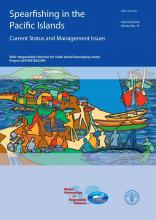
Spearfishing in the Pacific islands: current status and management issues
Biodiversity Conservation
Available Online

Gillett, Robert

,

Moy, Wayne

2006
Spearfishing is growing in importance in the Pacific Islands. While its management has featured as a topic in some regional-level meetings, detailed information on spearfishing is surprisingly scarce. In early 1994, the Secretariat of the Pacific Community (SPC) proposed to consolidate information on spearfishing in the Pacific Islands. The original intent was to undertake a review of the available literature through a desk study. With the realization that many issues related to spearfishing are undocumented, the strategy was changed to include some field work. These activities were supported by the FAO FishCode Programme. This report reviews spearfishing in selected Pacific Island countries and identifies the important species caught by and the major problems associated with the method. It further considers possible interventions to mitigate these problems and the assistance that is likely to be required by Pacific Island countries in the management of their spearfisheries. Visits to five countries undertaken during the study show that there are very large differences between countries, and between locations within a single country, in the level and type of spearfishing activities. General conclusions on the management of spearfishing include: (a) for several reasons, a complete ban of scuba spearfishing coupled with effective enforcement is the single most important spearfishing management measure; (b) spearfishing effort must be managed along with other forms of inshore fishing, since attempts at restricting spearfishing alone are not likely to be successful as fishing effort may b easily transferred to other small-scale fishing methods; and (c) in the management of inshore fisheries, including that of spearfishing, interventions must be formulated, initiated and enforced at the local level, preferably with some assistance from the national level.