Search the SPREP Catalogue

Refine Search Results

Tags / Keywords

Available Online

Tags / Keywords

Available Online

7965 result(s) found.

Sort by

You searched for

  • Collection Biodiversity Conservation
    X
Mainstreaming Ecosystem Services and Biodiversity into Agricultural Production and Management in the Pacific Islands - Technical guidance document
Biodiversity Conservation
Available Online

FAO

2016
The international community is increasingly aware of the link between biodiversity and sustainable development and its direct impact on wealth, health and well-being. Biodiversity is the origin of all crops and domesticated livestock. It is also the source of vital ecosystem services and functions, including soil conservation, water cycling, pollination, pest and disease regulation, carbon sequestration and nitrogen fixation. Biodiversity and the ecosystem services it supports are thus key to nutritional diversity and to agricultural productivity and resilience. The Convention on Biological Diversity (CBD) Strategic Plan for Biodiversity 2011–2020 and its 20 Aichi Biodiversity Targets provide a framework for countries to develop national targets and policies for sustaining biodiversity for a healthy planet. To meet rising global food demands, agricultural systems need to produce greater quantities of more diverse and nutritious food in a sustainable way. This progress can and must be achieved without driving biodiversity loss. It must come through gains in the efficiency of resource use, through sustainable intensification and a landscape perspective in agricultural production. By contributing to the conservation and sustainable use of biodiversity, agriculture will be a key driver for eliminating poverty, improving human health and providing energy, food and clean water for all while maintaining natural ecosystems.
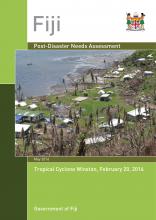
Fiji Post-Disaster Needs Assessment : Tropical Cyclone Winston, February 20, 2016
Biodiversity Conservation
Available Online

Ester, Simone

2016
On Saturday February 20, 2016, Tropical Cyclone (TC) Winston, an extremely destructive Category 5 cyclone, struck Fiji. TC Winston was the first Category 5 cyclone to directly impact Fiji and the most intense cyclone on record to affect the country.1 Fiji’s Eastern Division was the first to be struck, with Koro, Ovalau and Taveuni Islands sustaining severe damage. The cyclone swept across Fiji’s islands, reaching its peak strength shortly before making landfall on the country’s largest island, Viti Levu. Maximum average wind speeds reached 233km/hour and wind gusts peaked at around 306km/hour, making Winston one of the most powerful cyclones ever recorded in the Southern Hemisphere.2 In addition to the extreme wind speeds, many islands were flooded by storm surges, including Koro Island and the southern coast of Fiji’s secondlargest island, Vanua Levu, which was inundated almost 200 meters inland in some areas. Following TC Winston’s passage from Fiji, reports emerged of widespread damage and destruction, with the cyclone impacting approximately 540,400 people, equivalent to 62 percent of the country’s total population.3 The storm brought down the power and communications systems linking the islands, with approximately 80 percent of the nation’s population losing power, including the entire island of Vanua Levu, and 44 fatalities were subsequently confirmed. Entire communities were destroyed and approximately 40,000 people required immediate assistance following the cyclone.4 30,369 houses, 495 schools and 88 health clinics and medical facilities were damaged or destroyed. In addition, the cyclone destroyed crops on a large scale and compromised the livelihoods of almost 60 percent of Fiji’s population.
Framework for Resilient Development in the Pacific: An Integrated Approach to Address Climate Change and Disaster Risk Management (FRDP) 2017 - 2030
Climate Change Resilience, Biodiversity Conservation
Available Online
2016
Climate change exacerbates the magnitude and impacts of climate variability and some natural hazards. The existence of some Pacific Island countries (PICs) is threatened by climate change. Pacific Island countries and territories (PICTs) are highly exposed to a range of natural hazards of hydro-meteorological origin (such as cyclones, droughts, landslides and floods) and geological origin (including volcanic eruptions, earthquakes and tsunamis). These hazards often lead to disasters, which affect thousands of people and exacerbate existing development challenges in the region. Climate change predictions identify changes for the Pacific including an increase in extreme hot days and warm nights, extreme rainfall events, intensity of tropical cyclones in the South Pacific, sea level rise and ocean acidification. Climate change is increasing the risks from weather related disasters and posing new impacts to the region. Climate change impacts also cause progressive long-term degradation to the natural environment, to critical ecosystems (e.g. coral reefs), and to social and economic systems, resulting in loss and damage to the system upon which Pacific Island communities depend for their subsistence and livelihoods.