Search the SPREP Catalogue

Refine Search Results

Available Online

Available Online

10 result(s) found.

Sort by

You searched for

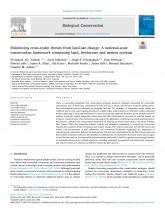
Minimizing cross-relam threats from land-use change: A national-scale conservation framework connecting land, freshwater and marine system
Environmental Governance, Biodiversity Conservation
Available Online

Atkinson, S.

,

Peterson, N

,

Possingham, H P

,

Tulloch, V J D.

,

et al.

2021
There is a growing recognition that conservation strategies should be designed accounting for cross-realm connections, such as freshwater connections to land and sea, to ensure effectiveness of marine spatial protection and minimize perverse outcomes of changing land-use. Yet, examples of integration across realms are relatively scarce, with most targeting priorities in a single realm, such as marine or freshwater, while minimizing threats originating in terrestrial ecosystems. To date, no study has optimized priorities across multiple realms to produce a spatially explicit integrated conservation plan that simultaneously accounts for multiple human activities at a national scale. This represents a major gap in the application of existing cross-realm planning theory. We present a national scale conservation framework for selecting protected areas using a case study of Papua New Guinea (PNG) that integrates multiple systems and ecological connectivity to account for cross-realm benefits and minimize threats of land-use and climate change. The relative importance of both the forests and inshore reef environments to PNG subsistence and commercial livelihoods emphasizes the importance of considering the connections between the land and sea. The plan was commissioned by the PNG Conservation and Environment Protection Authority and identifies a comprehensive set of priorities that meet conservation targets in both the land and sea. Our national-scale prioritization framework is useful for agencies and managers looking to implement actions given multiple objectives, including watershed management and biodiversity protection, and ensures actions are efficient and effective across the land and sea.
Special Issue Article: Tropical rat eradicationBest practice guidelines for rat eradication on tropical islands. Biological Conservation. Volume 185, May 2015
Biodiversity Conservation, BRB
Available Online

Boudjelas. S

,

Broome. K

,

Cranwell. S

,

Griffiths. R

,

Keitt. B

,

Millett. J

,

Pitt. W

,

Samaniego-Herrera. A.

2015
Invasive vertebrates are a leading cause of the extinction on islands and rats (Rattus spp.) are one of the most damaging to island ecosystems. Methods to eradicate rates from islands are well established and there have been over 580 successful eradications to date. Increasingly, rat eradications are being implemented on tropical islands, a reflection of the need to protect the threatened biodiversity in the tropics. Yet rat eradications on tropical islands fail more frequently than those in temperate climates. In an effort to identify the main reasons for the lower success rate on tropical islands and possible solutions, a workshop was convened with the 34 experts in rat eradication, tropical rodent and island ecology and toxicology. The workshop focused on projects using aerial broadcast of brodifacoum, a 2nd generation anticoagulant, because this approach had provided the highest success rate for eradicating rodents from islands. The workshop participants reviewed previously identified challenges to successful rat eradications on tropical islands including increased insect and crab densities resulting in competition for bait, year round or unpredictable timing of breeding rats and increased or unpredictable availability of alternative, natural foods. They also identified a number of new, likely reasons for the lower success rate on tropical islands and provided recommendations for how to address these risks in the planning and implementation of rat eradications. While the success rate of aerial broadcast rat eradications in tropical environments is quite high at 89%, it is hoped that by following the recommended best practices provided in this paper, future success rates will be closer to the 96.5% demonstrated for aerial broadcast rat eradication on temperate islands.