Search the SPREP Catalogue

13 result(s) found.

Sort by

You searched for

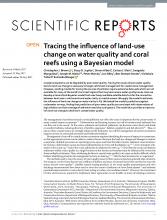
Habitat change mediates the response of coral fish populations to terrestrial run-off
Available Online

Albert, Simon

,

Brown, Christopher J.

,

Jupiter, Stacy D.

,

Klein, Carissa

,

Lin, Hsien-Yung

,

Maina, Joseph M.

,

Mumby, Peter J.

,

Tullock, Vivitskaia J. D.

,

Wenger, Amelia S.

2017
ABSTRACT: Coastal fish populations are typically threatened by multiple human activities, including fishing pressure and run-off of terrestrial pollution. Linking multiple threats to their impacts on fish populations is challenging because the threats may influence a species directly, or indirectly, via its habitats and its interactions with other species. Here we examine spatial variation in abundance of coral reef fish across gradients of fishing pressure and turbidity in Fiji. We explicitly account for multiple pathways of influence to test the alternative hypotheses that (1) habitat moderates predation by providing shelter, so habitat loss only affects prey fish populations if there are abundant predators, (2) habitat change co-drives biomass of both prey and predator functional groups. We examined responses of 7 fish functional groups and found that habitat change co-drives both predator and prey responses to turbidity. Abundances of all functional groups were associated with changes in habitat cover; however, the responses of their habitats to turbidity were mixed. Planktivore and piscivore abundance were lower in areas of high turbidity, because cover of their preferred habitats was lower. Invertivore, browser and grazer abundance did not change strongly over the turbidity gradient, because different components of their habitats exhibited both increases and decreases with turbidity. The effects of turbidity on fish populations were minor in areas where fish populations were already depleted by fishing. These findings suggest that terrestrial run-off modifies the composition of reef fish communities indirectly by affecting the benthic habitats that reef fish use.
Journal of South Pacific Law : Special Issue - Human Rights and Climate Change Law
Climate Change Resilience
Available Online

Aonima, C. & Kumar, S.

,

Bustreo, F.

,

Doebbler, C.

,

Fa'anunu, F.

,

USP

,

Wewerinke, M. & Fa'anunu, F.

2015
Climate change is often referred to as the defining challenge of our time, and it is well known that Pacific Island States are particularly vulnerable to the adverse effects of climate change. Indeed, these adverse effects are already very tangible for most communities across the region. Coastal features are visibly changing, with rising sea-levels, higher king tides and storm surges, saltwater intrusion and changing weather patterns posing an increasing threat to the livelihoods of Pacific Island communities. The threats are amplified by extreme weather events becoming more intense and more damaging as a result of climate change, with Cyclone Pam recently causing loss of human life and catastrophic damage in Vanuatu, and to a lesser extent in the Solomon Islands, Tuvalu and Kiribati. 2 While communities and governments—assisted by regional, international and nongovernmental organizations—are proactively building resilience and adapting to climate change, there is a real risk of much more severe and damaging impacts materializing in the coming decades.3 The threats are so severe that most, if not all, Pacific Island States face the threat of losing some or all of their habitable territory as a result of climate change, with related risks of the loss of traditional livelihoods and large-scale involuntary displacement