Search the SPREP Catalogue

12 result(s) found.

Sort by

You searched for

  • Available Online Yes
    X
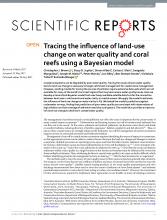
Habitat change mediates the response of coral fish populations to terrestrial run-off
Available Online

Albert, Simon

,

Brown, Christopher J.

,

Jupiter, Stacy D.

,

Klein, Carissa

,

Lin, Hsien-Yung

,

Maina, Joseph M.

,

Mumby, Peter J.

,

Tullock, Vivitskaia J. D.

,

Wenger, Amelia S.

2017
ABSTRACT: Coastal fish populations are typically threatened by multiple human activities, including fishing pressure and run-off of terrestrial pollution. Linking multiple threats to their impacts on fish populations is challenging because the threats may influence a species directly, or indirectly, via its habitats and its interactions with other species. Here we examine spatial variation in abundance of coral reef fish across gradients of fishing pressure and turbidity in Fiji. We explicitly account for multiple pathways of influence to test the alternative hypotheses that (1) habitat moderates predation by providing shelter, so habitat loss only affects prey fish populations if there are abundant predators, (2) habitat change co-drives biomass of both prey and predator functional groups. We examined responses of 7 fish functional groups and found that habitat change co-drives both predator and prey responses to turbidity. Abundances of all functional groups were associated with changes in habitat cover; however, the responses of their habitats to turbidity were mixed. Planktivore and piscivore abundance were lower in areas of high turbidity, because cover of their preferred habitats was lower. Invertivore, browser and grazer abundance did not change strongly over the turbidity gradient, because different components of their habitats exhibited both increases and decreases with turbidity. The effects of turbidity on fish populations were minor in areas where fish populations were already depleted by fishing. These findings suggest that terrestrial run-off modifies the composition of reef fish communities indirectly by affecting the benthic habitats that reef fish use.
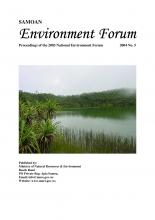
Samoan Environment Forum: proceedings of the 2005 National Environment Forum|The fact-or-myth of Samoan cultural heritage: personal reflections on family oral history / Tu'u'u Ieti Taule'alo|Samoan and Japan: concerns over mangroves development / Juliet Boon-Nanai|Status of hawksbill turtle nesting in Samoa, 2003/2004 / Mauigoa Lui Bell, Malama S. Momoemausu, Juney Ward & Malaki Iakopo|Participatory approaches for environmental initiatives - community consultation in Samoa / Natalie Mitchell|Emotional intelligence, management concept: a contributing factor for effective service delivery / Mulipola Ausetalia Titimaea|Tropical cyclone forecasting: theory and practical application - case study of tropical cyclone Olaf 2005 / Sala Sagato Tuiafiso|Samoa and the World Heritage Convention - is Samoa ready for world heritage listing / Tuiolo Schuster|Exploring the status of tsunami early warning systems in Samoa / Shaun P. Williams & Aliimalemanu F.M. Leavasa|Determination of a mean daily discharge values for Faleaseela River: implications for population water demand / Masina Nagau Chun, Iosefatu Eti & Mulipola A. Titimaea
Available Online

MNRE

2006
The community based conservation (CBC)paradigm predicts that sustainable biodiversity can only be achieved if local people perceive benefits from conservation. Through interviews, the situation in Samoa portrays that the CBC of mangroves was received with apprehension because the mangrove biodiversity was more significant than sustaining the livelihood of the local communities. In contrast, Iriomote Island residents were able to achieve maximum socio-economic benefits but to the extent that they were over commercializing the mangrove ecosystem. More research is imperative to find out how biodiversity conservation can be married with sustainable development objectives to sustain the local communities' livelihood.
Samoan Environment Forum: proceedings of the 2003 National Environment Forum|Fe'ese'esea'iga i aiga ma nuu o Samoa : aafiaga o le tofa i Tuana'i ma Saanapu / Tu'u'u Ieti Taulealo|Some prospects for managing Merremia peltata / William Stuart Kirkham|The Green turtle tour project : a successful approach to aiding natural resources management in Samoa / Funealii Lumaava Sooa'emalelagi & Steve Brown|Persistent Organic Pollutants and persistent toxic substances in Samoa's Environment / Taule'ale'ausumai Laavasa Malua, Bill Cable & Paul F. Heveldt|Bridging the gap: building environment information linkages & network - a Pacific Samoan model / Satui Bentin & Leilani Duffy|The MNRE model for institutional strengthening in the public sector / Tu'u'u Ieti Taule'alo & Moilevao Elisaia Talouli|SPREP in Samoa / F. Vitolio Lui|Samoa: a paradise lost? / Le Mamea Sefulu Ioane|Taking of customary land for the new Salelologa township / Patea M. Setefano, Vaitogi I Vaitogi, Faanimo Warren & Fiona Sapatu|A study of indigenous knowledge and its role to sustainable agriculture in Samoa / Pitakia Tikai & Aaron Kama|PABITRA (Samoa): promoting capacity building via biodiversity studies by young Samoans / Nat Tuivavalagi
BRB
Available Online

MNRE

2004
Merremia peltata, disturbance ecology, tropical cyclones and Samoa. The biology and ecology of Merremia peltata are not well understood. While some regard the species as an exotic invader of Pacific Island ecosystems (Meyer. 2000). others identify the plant as a native species likely to be harmful to native ecosystems (Whistler, 1995a. 2002) or as either native or ancient Polynesian introduction behaving invasively (Space and Flynn.(2002). In Samoa, this species occurs up to an elevation of around 300 meters (Whistler 1995a). and thus only affects lowland ecosystems. This species increases its distribution and abundance in two ways, either vegetatively. by sprawling into neighboring areas and rooting from its nodes or by seeds, although early research in the Solomons observed a low seed viability rate, and creeping may thus be its primary means of reproduction (Bacon. 1982). M. peltata has apparently been in the Pacific for hundreds of years (Whistler, pers. com.) but has only become invasive in the years following tropical cyclones Ofa (1990) and Val (1991) according to comments from local government officials. Disturbance thus appears to be an ecological contributing factor to this invasion.