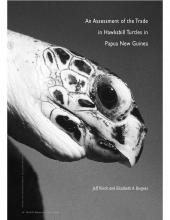
An assessment of the trade in Hawksbill turtles in Papua New Guinea
Burgess Elizabeth A
,
Kinch Jeff
2009
The trade in Hawksbill Turtles Eretmochelys imbricata, medium-sized cheloniids with a pan-tropical distribution, has been recognized as a key threat to their conservation in the wild, and has greatly contributed to the species being listed as Critically Endangered in the IUCN Red List (Milliken and Tokunaga, 1987; Groombridge and Luxmoore, 1989; Meylan and Donnelly, 1999; van Dijk and Shepherd, 2004; TRAFFIC Southeast Asia Indo china, 2004; Bräutigam and Eckert, 2006; Mortimer and Donnelly, 2007; IUCN, 2009). Sought after for its thick keratinous shell plates (often referred to as bekko or tortoiseshell), eggs, and sometimes meat, unsustainable harvest levels have endangered the Hawksbill Turtle throughout its distribution. Declines in populations in the Pacific have been widely reported (Hirth, 1971; Witzell and Banner, 1980; Pritchard, 1982; Balazs, 1983; Witzell, 1983; Johannes, 1986; Groombridge and Luxmoore, 1989; Miller, 1994; NMFS and USFWS, 1998; Meylan and Donnelly, 1999; Mortimer and Donnelly, 2007). Hawksbill Turtles and their eggs are widely used in Papua New Guinea for a variety of purposes, including subsistence, sale, barter (Spring, 1980, 1981, 1982a,b,c; Pernetta and Hill, 1981; Wright and Richards, 1983; Kinch, 1999, 2002, 2003a; Koczberski et al., 2006) and for celebrations at Christmas and the end of the school year, which coincide with the peak turtle nesting period in the austral summer months (Kwan, 1994; Kinch, 1999, 2002, 2003a). In many areas of Papua New Guinea, Hawksbill Turtles are also opportunistically taken as by-catch by fishers out on the reefs targeting lobsters, shellfish and sea cucumbers.