Search the SPREP Catalogue

Refine Search Results

Related Countries

Language

Available Online

Related Countries

Available Online

93 result(s) found.

Sort by

You searched for

  • Author PACC
    X
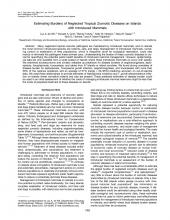
Estimating burdens of neglected tropical zoonotic diseases on islands with introduced mammals
BRB
Available Online

Croll, Donald A.

,

Holmes, Nick D.

,

Kilpatrick, A. Marm.

,

Newton, Kelly M.

,

Spatz, Dena R.

,

Tershy, Bernie.

,

de Wit, Luz A.

2017
Many neglected tropical zoonotic pathogens are maintained by introduced mammals, and on islands the most common introduced species are rodents, cats, and dogs. Management of introduced mammals, including control or eradication of feral populations, which is frequently done for ecological restoration, could also reduce or eliminate the pathogens these animals carry. Understanding the burden of these zoonotic diseases is crucial for quantifying the potential public health benefits of introduced mammal management. However, epidemiological data are only available from a small subset of islands where these introduced mammals co-occur with people. We examined socioeconomic and climatic variables as predictors for disease burdens of angiostrongyliasis, leptospirosis, toxoplasmosis, toxocariasis, and rabies from 57 islands or island countries. We found strong correlates of disease burden for leptospirosis, Toxoplasma gondii infection, angiostrongyliasis, and toxocariasis with more than 50% of the variance explained, and an average of 57% (range = 32–95%) predictive accuracy on out-of-sample data. We used these relationships to provide estimates of leptospirosis incidence and T. gondii seroprevalence infection on islands where nonnative rodents and cats are present. These predicted estimates of disease burden could be used in an initial assessment of whether the costs of managing introduced mammal reservoirs might be less than the costs of perpetual treatment of these diseases on islands.
Quantification and magnitude of losses and damages resulting from the impacts of climate change: modelling the transformational impacts and costs of sea level rise in the Caribbean
Climate Change Resilience
Available Online

Simpson, M.C...[et al.]

2010
The inextricable links between climate change and sustainable development have been increasingly recognised over the past decade. In 2007, the Intergovernmental Panel on Climate Change (IPCC)1 concluded with very high confidence that climate change would impede the ability of many nations to achieve sustainable development by mid-century and become a security risk that would steadily intensify, particularly under greater warming scenarios. Article 4.8 of the United Nations Framework Convention on Climate Change (UNFCCC) lists several groups of countries that merit particular consideration for assistance to adapt to climate change “especially: (a) small island countries, (b) countries with low-lying coastal areas, c) countries with areas prone to natural disasters.” Small Island Developing States (SIDS) have characteristics which make them particularly vulnerable to the effects of climate change, sea level rise (SLR) and extreme events, including: relative isolation, small land masses, concentrations of population and infrastructure in coastal areas, limited economic base and dependency on natural resources, combined with limited financial, technical and institutional capacity for adaptation.2