Search the SPREP Catalogue

Refine Search Results

Related Countries

Language

Available Online

Related Countries

Available Online

15 result(s) found.

Sort by

You searched for

Threats to mangroves from climate change and adaptation options
Climate Change Resilience, Biodiversity Conservation
Available Online

Duke Norman C

,

Ellison Joanna

,

Field Colin

,

Gilman, Eric L

2008
Mangrove ecosystems are threatened by climate change. We review the state of knowledge of mangrove vulnerability and responses to predicted climate change and consider adaptation options. Based on available evidence, of all the climate change outcomes, relative sea-level rise may be the greatest threat to mangroves. Most mangrove sediment surface elevations are not keeping pace with sea-level rise, although longer term studies from a larger number of regions are needed. Rising sea-level will have the greatest impact on mangroves experiencing net lowering in sediment elevation, where there is limited area for landward migration. The Pacific Islands mangroves have been demonstrated to be at high risk of substantial reductions. There is less certainty over other climate change outcomes and mangrove responses. More research is needed on assessment methods and standard indicators of change in response to effects from climate change, while regional monitoring networks are needed to observe these responses to enable educated adaptation. Adaptation measures can offset anticipated mangrove losses and improve resistance and resilience to climate change. Coastal planning can adapt to facilitate mangrove migration with sea-level rise. Management of activities within the catchment that affect long-term trends in the mangrove sediment elevation, better management of other stressors on mangroves, rehabilitation of degraded mangrove areas, and increases in systems of strategically designed protected area networks that include mangroves and functionally linked ecosystems through representation, replication and refugia, are additional adaptation options.
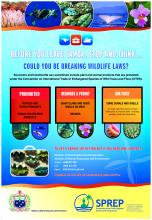
Samoan Environment Forum: proceedings of the 2005 National Environment Forum|The fact-or-myth of Samoan cultural heritage: personal reflections on family oral history / Tu'u'u Ieti Taule'alo|Samoan and Japan: concerns over mangroves development / Juliet Boon-Nanai|Status of hawksbill turtle nesting in Samoa, 2003/2004 / Mauigoa Lui Bell, Malama S. Momoemausu, Juney Ward & Malaki Iakopo|Participatory approaches for environmental initiatives - community consultation in Samoa / Natalie Mitchell|Emotional intelligence, management concept: a contributing factor for effective service delivery / Mulipola Ausetalia Titimaea|Tropical cyclone forecasting: theory and practical application - case study of tropical cyclone Olaf 2005 / Sala Sagato Tuiafiso|Samoa and the World Heritage Convention - is Samoa ready for world heritage listing / Tuiolo Schuster|Exploring the status of tsunami early warning systems in Samoa / Shaun P. Williams & Aliimalemanu F.M. Leavasa|Determination of a mean daily discharge values for Faleaseela River: implications for population water demand / Masina Nagau Chun, Iosefatu Eti & Mulipola A. Titimaea
Available Online

MNRE

2006
The community based conservation (CBC)paradigm predicts that sustainable biodiversity can only be achieved if local people perceive benefits from conservation. Through interviews, the situation in Samoa portrays that the CBC of mangroves was received with apprehension because the mangrove biodiversity was more significant than sustaining the livelihood of the local communities. In contrast, Iriomote Island residents were able to achieve maximum socio-economic benefits but to the extent that they were over commercializing the mangrove ecosystem. More research is imperative to find out how biodiversity conservation can be married with sustainable development objectives to sustain the local communities' livelihood.